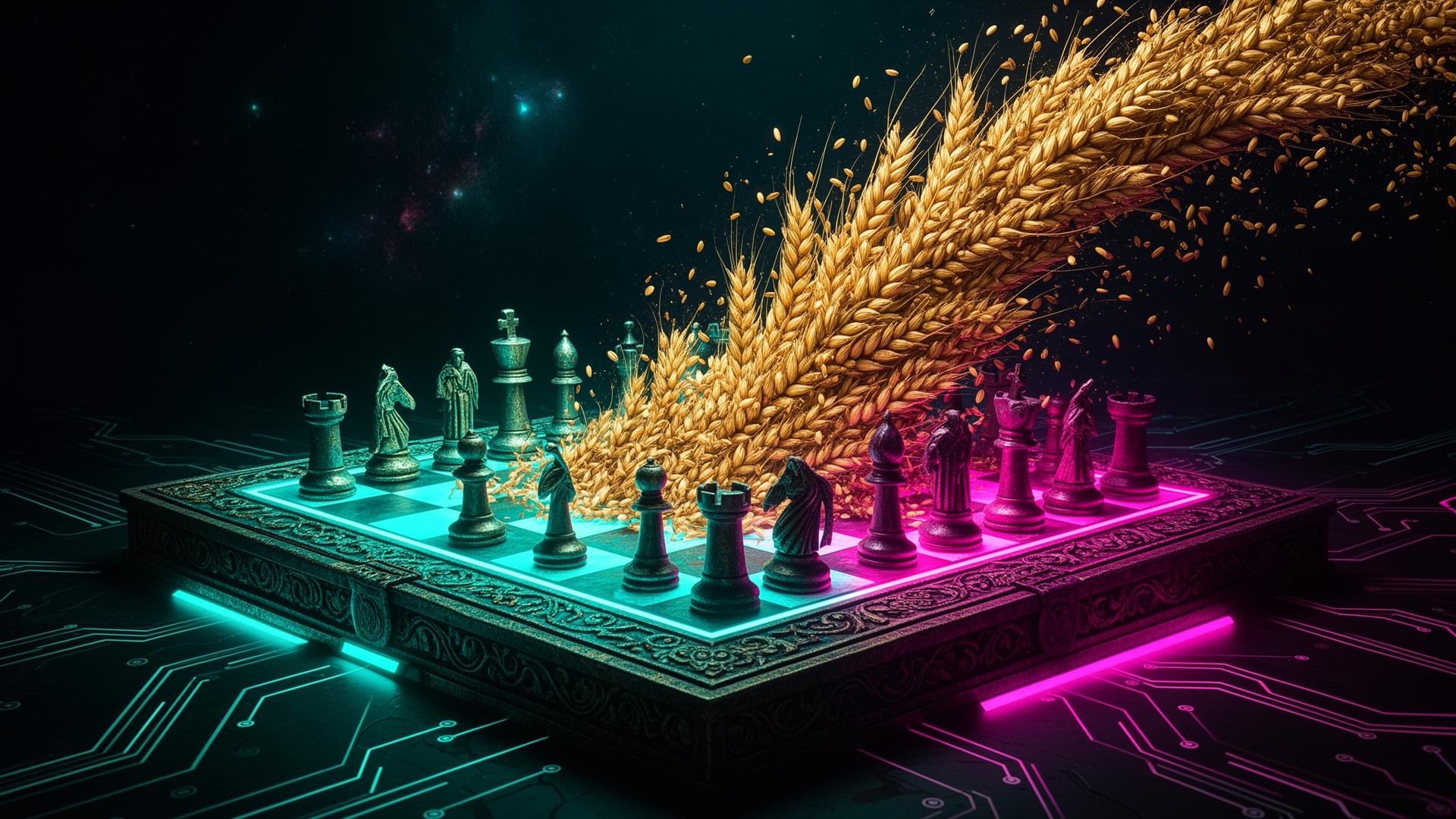

You are probably underestimating the next decade of AI by a factor of around two billion. So is everyone in your industry. The reason has nothing to do with AI. It has to do with a chessboard, a king, and a piece of math that the human brain is built to misread.
Here is the story.
There is a tale, first recorded in 1256 by the historian Ibn Khallikan, about an ancient Indian minister named Sessa who built a game of war that required no soldiers. He brought it to his king. The king played, lost, played again, and asked Sessa to name his reward.
Sessa requested wheat. One grain on the first square of the board. Two on the second. Four on the third. Double the count on each successive square until the sixty fourth.
The king laughed. He was a generous man and a poor mathematician, which is a dangerous combination. He ordered the treasurer to fetch a sack of grain and pay the inventor his trivial sum.
The treasurer returned hours later, ashen. There was not enough wheat in the kingdom. There was not enough wheat in the world. To pay Sessa would require roughly eighteen quintillion grains, weighing more than a trillion metric tons, on the order of sixteen hundred times the entire annual global wheat harvest of the modern era.
Versions of the story diverge on what happened to Sessa. In some he becomes the king's chief advisor. In others, executed. The variance is interesting. The king's anger is understandable in either case. He had been outmaneuvered by a function he could not see, in a contract he could not read.
I think about Sessa often. I think about him because I am living, professionally and personally, inside the same misunderstanding the king made, and so are most of the people I work with, and so, almost certainly, are you.
The Shape of the Function
Let us pause on the math, because the math is the entire argument.
A chessboard has 64 squares. If you double a grain of wheat on each one, you end with a number too large for ordinary intuition. But the surprise is not at the end. The surprise is in the middle.
The first half of the board, squares one through thirty two, holds about 279 tonnes of wheat. A substantial amount. A grain elevator's worth. You could load it onto a few freight trucks. Sessa's king, if he had looked only at the first half, would have been embarrassed but solvent.
Then comes the 33rd square.
The 33rd square alone contains more grain than the entire first half of the board. Read that again. One square outweighs thirty two squares. And the 34th square doubles the 33rd, and the 35th doubles the 34th, and by the time you reach the 64th, that final square holds over nine quintillion grains, more than two billion times what the first half of the board ever held.
Ray Kurzweil, the futurist, gave this phenomenon a name. He called it the second half of the chessboard. It is the point at which an exponential function, having quietly compounded in the background, breaks loose from any frame of reference that a linear observer can hold in mind.
Sessa's king made a contract on the first half. The bill came due on the second half.
A Note on Where I Am Writing From
I am writing this as a practicing attorney with fifteen years of trial work behind me, and as someone who has spent the last three years building artificial intelligence into the daily work of law firms. I have watched a handful of industries get reshaped by technology from the inside. Drones. Cloud. Mobile devices. I have never seen geometry this clean.
The reason I am writing the essay you are reading is that I believe the cost of being wrong about this curve, for any professional whose income depends on knowledge, is asymmetric in a way that almost nobody is pricing correctly. The downside of being too aggressive is that you build a better firm than you needed. The downside of being too conservative is that you do not have a firm.
Now, the cognitive science.
Why You Cannot See It
Human brains are not built for exponentials. We are built for the savanna, for tracking the movement of antelope and counting the moons until winter. Our perceptual machinery, going back at least as far as Weber and Fechner in the nineteenth century, measures the world logarithmically and reports it linearly. A noise that is twice as loud, in physical terms, registers as only slightly louder in our heads. A light four times as bright feels merely brighter.
This is not a flaw. It is an excellent compression algorithm for a world in which most variables move slowly and most threats arrive at predictable rates. The mistake is in assuming that the world we evolved for is the world we now inhabit.
When you ask a person to forecast the next ten years of a technology, they do not run the exponential in their head. They run a line. They take the last few years of change, draw a ruler, and extend it forward. If a technology improved by ten percent last year, they predict ten percent next year. This is rational under normal circumstances, because most technologies actually do behave linearly. Aircraft cruise speeds have barely moved in fifty years. Car fuel economy creeps upward by single digits per decade. Even the most consequential industrial technologies — electricity, steel, antibiotics — follow long S curves that look linear during their middle decades.
The error is in applying this same intuition to a technology that is not behaving linearly. The error is in being Sessa's king at the 33rd square.
What an Exponential Actually Looks Like
For the better part of sixty years, the price of computation has fallen by roughly half every two years. This is Moore's Law, and it is the closest thing the modern economy has to a law of physics. It does not feel like an exponential when you live inside it, because at any given moment the next doubling is only a doubling. The phone in your pocket is a bit better than the one you had three years ago. The cloud bill is slightly cheaper. The chip in your laptop is incrementally faster. Nothing about your daily experience screams quintillion.
But the curve has been running.
Layered on top of falling compute costs, the artificial intelligence community discovered something around 2019 that surprised even the researchers running the experiments. If you take a neural network and you scale its parameters, its training data, and the compute thrown at it, its capabilities do not just grow incrementally. They grow predictably along a curve, and the curve is exponential in compute. The phrase the researchers settled on, somewhat soberly, was scaling laws. Training compute for frontier AI systems has roughly doubled every six to ten months for the better part of a decade — a rate that makes Moore's Law look sleepy.
Stack these two exponentials on top of one another and the picture is not subtle. Cost per unit of intelligence is falling by roughly an order of magnitude every couple of years. Capability per dollar is climbing on a curve that, when you plot it on a logarithmic chart, looks like a straight line, and when you plot it on a linear chart, looks like a wall.
Most people, including most professionals in industries that AI is about to reshape, are looking at the linear chart.
I want to be careful here, because I am a lawyer by training and not a futurist, and forecasting is the easiest way to embarrass yourself in print. I cannot tell you what AI will do in 2030. I can tell you what the function has been doing for ten years, and I can tell you that the function does not know that 2030 is the year you wanted it to slow down.
The First Half Reasoning Error
If you are a lawyer, an accountant, an architect, a consultant, a financial advisor, a doctor, a software engineer, a journalist, a designer, or anyone else whose income depends on what you know, the rest of this essay is about you. The geometry does not care which knowledge you sell. It cares that you sell knowledge.
In my own field, the law, I watch firms make a particular kind of bargain with the future. They say, in effect, "AI is interesting. We are piloting some tools. We are exploring its uses. We expect a productivity bump of maybe ten or fifteen percent over the next few years."
This is not a wrong sentence. Over the past three years, in many firms, it has been roughly correct. But it is a first half sentence. It is the king at square 16, looking at his single sack of wheat, calculating that even at square 32 he will only owe a few freight trucks, and concluding that the bargain is fine.
It is not fine.
The 33rd square in legal practice will not look like a slightly better contract review tool. It will look like a junior associate who can read every filing in a jurisdiction overnight, draft a motion that survives appellate scrutiny, and walk a client through the consequences of three settlement options before lunch. The 34th square will look like that same associate billing nothing per hour. The 35th square is not a thing I can describe to you, because I am Sessa's king and so are you.
What I can describe is the structure of the bargain. Firms that are pricing AI as a ten percent productivity gain are pricing the first half of the board. Firms that are restructuring their entire model around AI as a capability that doubles every twelve to eighteen months are pricing the second half. The first group will be very surprised in 2028 or 2029. The second group will not.
This is not a prediction. It is geometry.
The same calculation applies, with different specifics, to accountants pricing automated audit, to architects pricing generative design, to physicians pricing diagnostic AI — to anyone whose work product is a structured artifact assembled from training and judgment. Different industries will hit their 33rd squares in different quarters. None will be exempt.
Why Smart People Get This Wrong
The hardest part of this argument is not the math. The math is, frankly, sixth grade. The hardest part is that smart, sober, experienced people consistently look at exponential evidence and produce linear forecasts, and they do so for reasons that are, in isolation, completely reasonable.
The first reason is that exponentials look linear inside any short window. If you sample three or four data points from a doubling curve, you cannot reliably distinguish them from a steep linear trend. The only way to detect the curve is to integrate over a longer window than most people are comfortable extrapolating across.
The second reason is that prior technological exponentials have, in fact, slowed down. Moore's Law was supposed to end multiple times. It has bent and creaked and shifted from clock speed to parallelism to specialized hardware, but the underlying cost curve has kept moving. Many smart people in 2010 reasonably forecast a slowdown that did not arrive, and they paid for that forecast in equity.
The third reason, and this is the one that is hardest to hear, is that taking exponentials seriously requires acting against the consensus of one's peers. If you are a partner at a firm and you tell your colleagues that your industry will be unrecognizable in five years, you will be wrong for four of those years and right for the fifth. Most people do not have the temperament, or the institutional cover, to be wrong for four years in a row. Sessa's king did not have a chief economist whispering in his ear that the wheat math was sound. He had a court full of people nodding that a few sacks of grain was a fair price.
Carl Sagan, in the second chapter of his last book, returned to this same chessboard. He used it to write about bacteria, and the way an exponential cannot continue forever because it eventually consumes its substrate. He was warning, mostly, about ecology. But his sentence applies just as cleanly to capability. Exponentials cannot run forever, but they can run long enough to reorganize the world before they bend.
The honest position is not that AI will compound at its current rate until it consumes the universe. The honest position is that we do not know when the curve will bend, and that the cost of being wrong about the bending is asymmetric. If you plan for the second half and the curve flattens early, you have built a better firm than you needed. If you plan for the first half and the curve does not flatten, you do not have a firm.
The Identity Question
If the wheat and chessboard problem has a moral, I think it is not about wheat or kings. It is about who you are choosing to be when you sign a contract you do not fully understand.
The king, in every version of the story, is a sympathetic figure. He is generous. He keeps his word, mostly. He has the misfortune of being asked to think exponentially in a culture that did not yet have the math for it. His error is forgivable. We do not have that excuse. The math has been in textbooks for centuries. The curves are public. The data is on the internet for free.
The choice now is not whether the exponential is running. It is running, and your industry is on it, and so is mine. The choice is whether you are someone who plans on the first half of the board or someone who plans on the second.
I am someone who plans on the second half. Not because I am brave, or smarter than the people who do not, but because I have spent enough nights staring at the curves to find them more credible than my own intuition. The intuition says ten percent. The curves say something else. When the two disagree, I trust the curves, and I build accordingly.
This is what we are building at LegalTek.ai. Not a tool that makes a lawyer ten percent faster. A platform that assumes the capability per dollar of legal AI will be unrecognizable in three years, and that the firms that survive will be the ones that designed for the wall, not the slope.
Sessa's king lost his kingdom over the difference between two lines.
Here is what I am going to ask of you. Tell me one number: which square do you think your own industry is sitting on right now. Not where you wish it was. Where the math says it is.
We have the advantage of knowing the story. There is no reason to repeat it.
Matthew A. Mishak is the Managing Attorney of Mishak Law LLC and Founder / CEO of LegalTek.ai (d/b/a SilverTung).
Jason L. Kelleher is a contributor.