
From Turing to Deep Learning: A Brief History of AI Vision
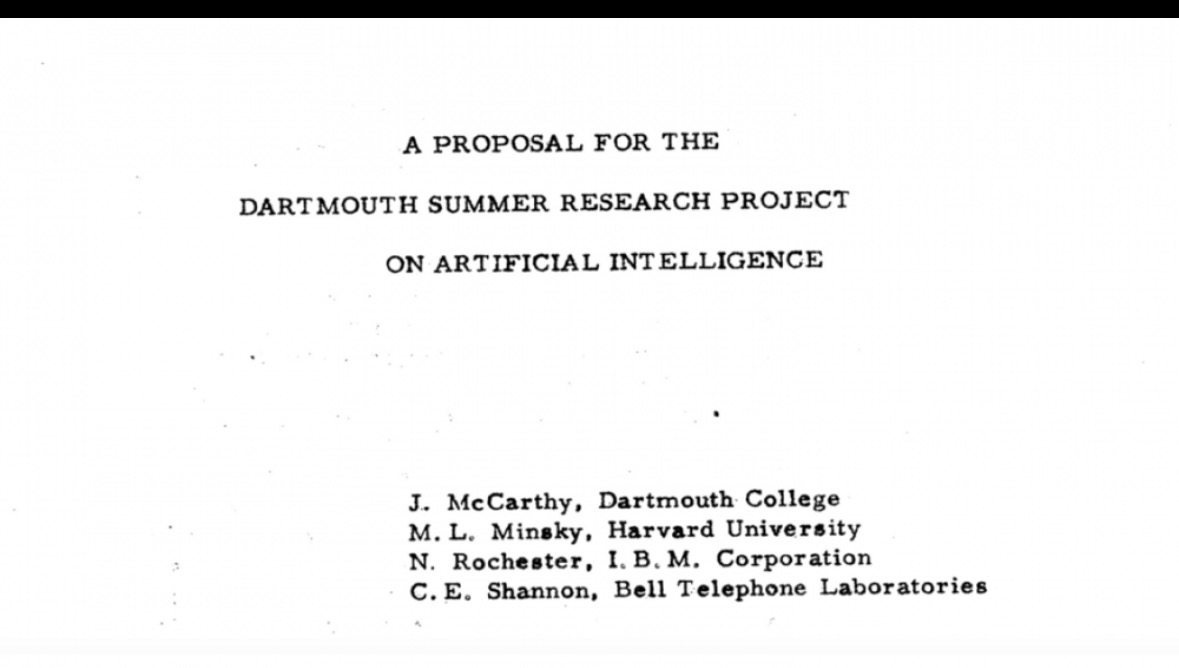
Cover page of the 1955 Dartmouth proposal that coined the term "Artificial Intelligence."
The quest to build thinking machines dates back over half a century. In 1950, Alan Turing famously asked "Can machines think?", laying the philosophical groundwork for artificial intelligence (AI). A few years later, in 1956, the field of AI was born at the Dartmouth Summer Research Project – where pioneers like John McCarthy and Marvin Minsky optimistically conjectured that "every aspect of learning or any other feature of intelligence" could be precisely described and simulated by a machine.
Progress proved slower than those early visionaries imagined. The decades after Dartmouth saw cycles of excitement and setbacks – from initial successes in game-playing and symbolic reasoning, to periods of disillusionment (the "AI winters") when grand promises went unfulfilled. Yet the dream persisted.
By the 21st century, breakthroughs in machine learning reignited the field. In particular, deep learning – pioneered by Geoffrey Hinton, Yoshua Bengio, and Yann LeCun – enabled computers to learn from vast data in ways never before possible. A watershed moment came in 2012 when a neural network trained on Fei-Fei Li's ImageNet database achieved superhuman image recognition, shocking the community and ushering in today's AI renaissance.
"AI's recent success stems from the ability to scale data and computation along with new algorithms – finally allowing machines to 'see' and interpret the world with uncanny accuracy."— Fei-Fei Li, AI Pioneer
The Dawn of Superhuman AI: Predictions and Timelines
AI is now advancing at an exponential pace. "AI is the new electricity," declares Andrew Ng – underscoring that just as electricity transformed every industry a century ago, AI stands to do the same now. Systems like OpenAI's GPT-4 and DeepMind's AlphaGo have already matched or exceeded human performance in domains ranging from language to complex strategy games.

This rapid progress has led experts to dramatically revise their forecasts for artificial general intelligence (AGI) – machines with human-level (or greater) cognitive abilities. Leading AI labs believe the world may see superhuman AI within this decade:
Demis Hassabis, CEO of DeepMind
"AGI is somewhere between five and 10 years away."
Sam Altman, CEO of OpenAI
AGI could arrive within the next U.S. presidential term.
Ray Kurzweil, Futurist
"By 2029, AI will pass a valid Turing test."
Richard Susskind
AI neural network performance doubles every 3.5 months – a 300,000-fold improvement in six years.
Kurzweil further pinpointed 2045 as the year of the "Singularity" – a theoretical inflection point when machine intelligence surges past human intelligence, triggering "runaway technological growth" and "unfathomable changes to human civilization."
"I'd be very worried about society today if I didn't know that something as transformative as AI was coming. AI-driven scientific discovery could eliminate diseases, reverse climate change, and usher in an era of abundance and peace."— Demis Hassabis
Mustafa Suleyman agrees that "over the next 10 years, AI will be the greatest force amplifier in history", driving "the greatest, most rapid acceleration in wealth and prosperity in human history." The convergence of AI with other innovations is "ushering in a new dawn for humanity, creating wealth and surplus unlike anything ever seen."
Existential Dilemmas: Risks and Ethical Challenges
Against this backdrop of excitement, experts also sound alarms about the profound risks of advanced AI. Geoffrey Hinton – often called the "godfather of deep learning" – made headlines in 2023 by resigning from Google to warn about AI's dangers. He now believes there is a "10% to 20%" chance that AI will lead to human extinction within the next three decades.
"We've never had to deal with something more intelligent than ourselves. Once machines become smarter than us, controlling them may become impossible. Humans could end up like toddlers compared to ultra-intelligent AI."— Geoffrey Hinton
Mustafa Suleyman likewise emphasizes the double-edged sword of this "coming wave." "Our future both depends on these technologies and is imperiled by them," Suleyman writes, calling this wave "an immense challenge that will define the twenty-first century."
A core dilemma is that AI and related tech are advancing too quickly to easily govern. The competitive dynamics between nations and corporations create relentless pressure to push AI development forward. As Suleyman notes, "no wave of technology has, so far, been contained", and "there is no central authority" globally that controls what gets built.
Fei-Fei Li argues for a "human-centered AI" approach: we should design AI systems that augment human capabilities and reflect our values, rather than aiming to replace humans wholesale.
"The most important use of a tool as powerful as AI is to augment humanity, not to replace it. Human dignity, human well-being – human jobs – must remain at the center of AI development."— Fei-Fei Li
The Future of Law in an AI-Driven World
No field will be left untouched by the AI revolution – least of all the legal sector, which runs on information and logic that AI is increasingly adept at handling. We are already seeing early signs of AI disruption in law: legal research and e-discovery tasks automated by machine learning, contract analysis done by natural language processors, even "AI lawyers" assisting with brief writing and case prediction.
But according to legal technology expert Richard Susskind, the biggest changes are still to come:
"AI will not transform legal and court services within the next two years, but it will do so in the late 2020s and beyond. Many claims about immediate AI-driven upheaval hugely overstate the near-term impact; yet most long-term predictions hugely understate its impact."— Richard Susskind
Susskind argues that the greatest impact "will not be in simply automating or replacing tasks currently undertaken by human lawyers." Instead, AI will enable delivering legal services in entirely new ways that better meet client needs. He urges lawyers to adopt a "client-centric" perspective: rather than asking how AI will replace lawyers, ask how it will improve access to justice and outcomes for clients.
The consensus is that lawyers who embrace AI will augment their capabilities, while those who ignore it may fall behind. As one observer quipped, "AI will handle the paperwork. We will handle the strategy." The likely scenario is not "AI vs. Lawyers" but "AI for Lawyers."
The COUNSEL Framework
To prepare for this future, the legal profession is beginning to establish frameworks and standards for ethical AI adoption. One example is the COUNSEL framework (developed by LegalTek), which aligns AI use with core professional responsibilities:
Confidentiality
Protect client data and attorney-client privilege
Oversight
Maintain human supervision of AI outputs
Understanding
Know how AI tools work and their limitations
Notifying
Inform clients about AI use in their matters
Scrutinizing
Verify AI outputs for accuracy and bias
Equitable fees
Adjust billing to reflect AI efficiencies
Lifetime learning
Continuously update AI competencies
Embracing the Future: A Roadmap for the Decades Ahead
Drawing together these expert insights, we can chart a roadmap for the AI-powered future – in law and across society:
Immediate Term: Incremental Integration
Expect continued incremental adoption of AI tools. Lawyers and professionals should start using AI assistants for research, drafting, and routine tasks (under human supervision). Organizations must invest in training their workforce on AI literacy and update policies.
KEY ACTION: Embrace AI gradually, focus on learning and ethical use. Build foundations in skills, data infrastructure, and pilot projects.
Inflection Point: Transformation Begins
By the late 2020s, we anticipate more capable AI systems truly entering the mainstream. AI may achieve or approach AGI-level abilities in certain domains by 2030. Many professional tasks will be re-engineered around AI collaboration. Online courts and AI-driven dispute resolution might become common for simpler cases.
KEY ACTION: Develop robust governance. Implement AI regulations, safety nets, and international coordination.
Long Term: New Paradigms & The Singularity
If current trends hold, AI could far exceed human-level intelligence across many fields. Kurzweil's vision of the 2040s sees humans merging with AI – leveraging brain-computer interfaces and cloud intelligence. Education, employment, and law itself will need radical rethinking.
KEY ACTION: Reinvent human institutions. Ensure guardrails are effective before AI vastly surpasses us. Develop global monitoring and fail-safe mechanisms.
Conclusion: Shaping a Future That Serves Humanity
The journey ahead for AI is both exhilarating and daunting. It is no longer science fiction to imagine superhuman intelligences working alongside us, or even altering the course of human history. Indeed, "the speed and power of this new revolution has been surprising even to those of us closest to its cutting edge," Suleyman admits. But the message from experts is clear: the future is not predetermined. We hold the responsibility to direct AI for social good.
In practical terms, that means engagement and vigilance. Lawyers, policymakers, engineers, business leaders, and citizens all have a role to play in shaping the AI revolution. Richard Susskind reminds us to always ask not just what AI means for lawyers, but what it means for clients and society. Fei-Fei Li reminds us that AI's values must be human values. And figures like Hinton remind us that unchecked technological leaps can carry catastrophic risk – so we must develop AI wisely and safely.
"Lawyers who embrace AI will stay ahead, because they will reshape their work rather than be replaced. The same can be said for all of us: by embracing AI's potential and confronting its challenges head-on, we can ensure that this transformative technology becomes a tool of progress and justice."
The future is coming fast. It's up to us to navigate the wave and build a future where AI and humanity thrive together – a future in which the rule of law, and the values we cherish, endure in the age of intelligent machines.
Ready to Implement AI Ethically?
Explore the COUNSEL Framework for responsible AI adoption in legal practice.