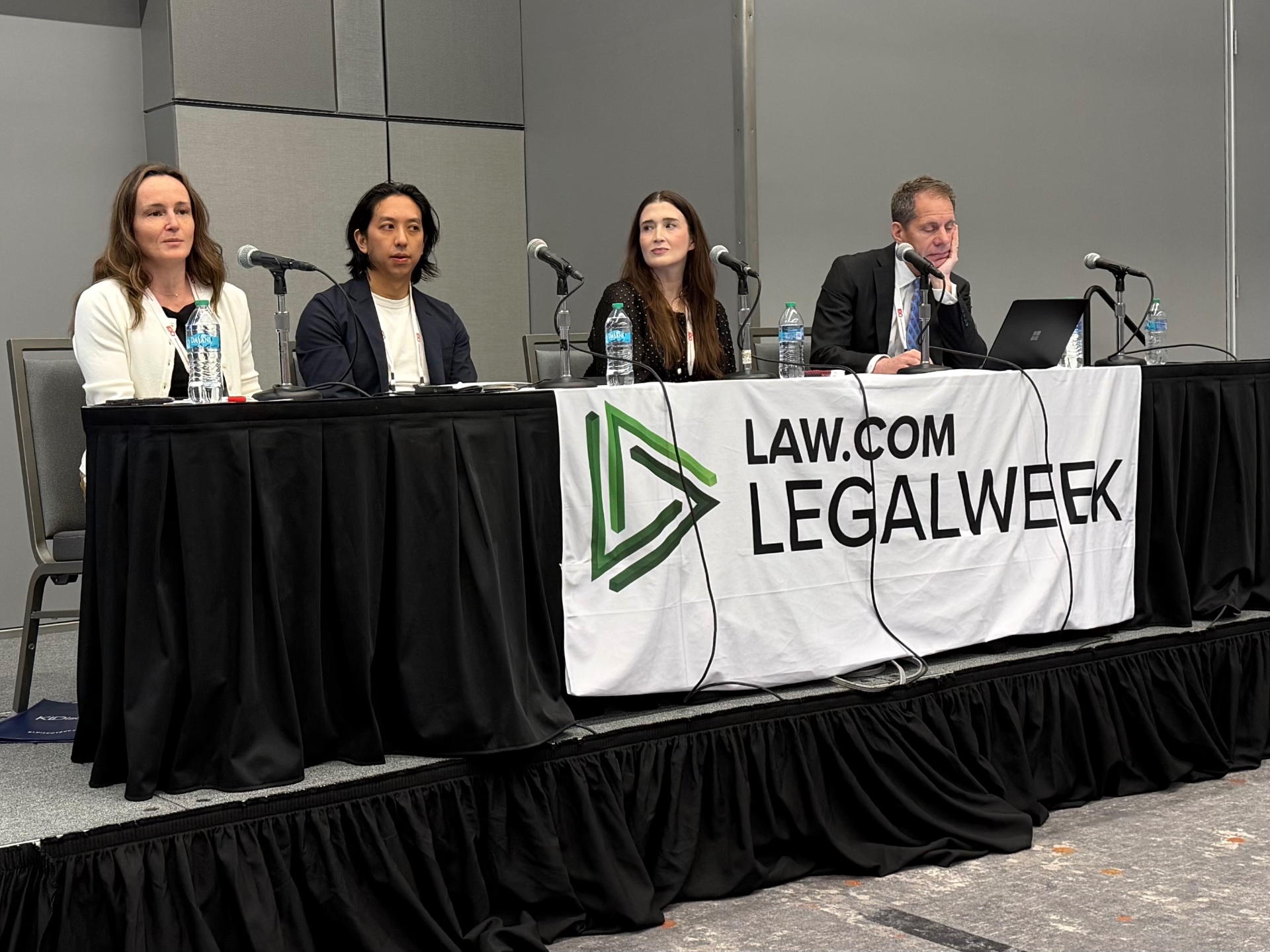
At this year's LegalWeek, the session "AI Agents 101: What They Are and Why They Matter" brought together a sharp panel to tackle a question that's rapidly moving from theoretical to operational: What does agentic AI actually mean for legal practitioners, and how do we build it responsibly?
The session cut through the marketing noise surrounding agentic AI and delivered a grounded, practitioner-focused conversation about workflows, guardrails, governance, and the adoption curve confronting legal professionals. Here's what stood out.
Defining "Agentic" — Beyond the Buzzword
The panel opened with a deceptively simple question: How do you define agentic AI?
Bucket 1: Workflow Agents
Systems that follow prescribed guardrails and conditional logic — if X happens, do Y. Most of what the legal industry works with today falls here.
— Ethan Wong, Anthropic
Bucket 2: Autonomous Agents
Systems that exercise independent judgment when given a general task without explicit rule sets. The future, not the present.
— Ethan Wong, Anthropic
The Orchestration Metaphor
Kassi Burns introduced a metaphor worth remembering: think of agentic AI as orchestration. An agentic system isn't one monolithic tool doing everything. It's a coordinated arrangement of sub-components — different foundation models handling different sub-tasks, pulling from different data layers, with an orchestration layer overseeing the entire process.
John Rosenthal delivered perhaps the panel's most candid assessment: much of what's being marketed as "agentic AI" doesn't really qualify. We're still in the very early innings. Most current tools are sophisticated prompting wrapped in a workflow structure. The real evolution will unfold over the next two to three years as the industry moves from single-prompt systems to multi-agent architectures where coordinated agents work together to deliver complex outputs.
Practical Use Cases Today
The panelists shared concrete examples of how they're actually using agentic workflows right now — and the practical, roll-up-your-sleeves nature of the discussion was refreshing.
Anthropic's Internal Legal Triage
Wong described how his own legal team built a platform using Claude to triage thousands of internal outside-business-activity requests. The system intakes employee requests (speaking engagements, consulting gigs, etc.), asks follow-up questions, and then prioritizes which ones genuinely need legal review versus which can be cleared automatically.
Rosenthal's Weekend Builds
Rosenthal described spending weekends building agentic workflows to solve real problems: a case law update agent that scans resources and produces a daily digest (built in about ninety minutes), and a timekeeping agent that scans his mailbox and desktop to generate time entries with a link into his firm's billing system.
Burns on Repeatable Processes
Burns emphasized identifying repeatable processes well-suited for AI involvement — particularly those with sufficiently low risk to allow for guardrails. He highlighted Zapier as a learning tool: building even simple conditional workflows forces attorneys to think in components — a cognitive shift foundational to building effective agentic systems.
The Guardrails Question — And Why It Matters More Than You Think
This is where the panel's discussion became most consequential for practitioners.
Anthropic's Multi-Layer Guardrail Architecture
Safety Training
Built into the model itself
Classifiers
Flag potentially malicious requests
Skill Parameters
Prescribe & constrain agent behavior
MCP Scoping
Limit data & system access
Rosenthal's Enterprise Warning
"We are creating agents that will sit in organizations for years, and we don't know whether they're current, who created them, whether they contain privacy risks, whether their results have been validated against authoritative sources, or whether they're accessing data they shouldn't be."
Without what Rosenthal called a compliance wrapper, the enterprise risk is substantial. Organizations need to involve their compliance teams early — because compliance already knows where the high-risk data and high-risk activities reside.
The Question I Asked: Legislation, Life-and-Death Decisions, and the Guardrails Gap
"Given the current conversation around AI in military and life-or-death decision-making contexts — including the recent controversy involving the Department of Defense and Anthropic — and given that the law consistently lags behind the technology, how do we navigate a landscape where technology companies want guardrails but existing law doesn't provide for them?"
— Matthew A. Mishak, from the audience Q&A
Rosenthal's response was direct: providers want legislation primarily because they want safe harbor protection. Without it, the product liability cases are going to flow — claims involving consumer harm, medical advice, children's exposure to AI, and more.
His recommendation for organizations? Go back to policy and training. Establish practical guidance, train on it, and recognize that paper tigers don't work. He noted that even among Am Law 100 firms, only about half have AI policies in place, and virtually none have published AI policies to their clients.
The Hallucination Problem Doesn't Disappear at the Agentic Layer
Rosenthal raised a point that should give every legal technology builder pause: much of what's being built in the agentic AI space is still built on generative AI foundations, and generative AI can hallucinate at significant rates. When you embed that hallucination risk into automated workflows, there's a real danger that users become numb to inaccuracies — the same way many users now treat Google's AI summaries as authoritative despite frequent errors.
Unless the governance and validation infrastructure is built into the agent itself (not just the underlying foundation model), the enterprise risk compounds with every layer of automation.
Data Hygiene: The Unsexy Foundation
A recurring theme — less glamorous but arguably more important than any individual tool — was data curation. Burns emphasized that the data feeding into agentic workflows must be clean, robust, and rigorously curated.
Garbage in, garbage out isn't just a cliché in this context — it's a direct cost driver when workflows operate on token-based pricing models. Every piece of junk data an agent processes costs money and degrades output quality.
Adoption: Why Everyone Feels Behind
Perhaps the most humanizing moment of the panel came when even Anthropic's own product counsel, Ethan Wong, admitted to feeling behind on building personal agentic workflows. The adoption challenge is real.
Speed Mismatch
Technology moves faster than any individual can track
Cognitive Shift
Building effective workflows requires slowing down and thinking methodically
Workload Layering
Most attorneys layer AI on top of already-full workloads
The Panel's Consensus
Start building, even if it's small. Play with Claude Code, build a simple skill, experiment with Zapier or Copilot Studio. The iterative process of building — breaking tasks into sub-components, identifying failure points, testing and refining — is itself the most valuable learning experience.
What This Means for Legal Tech Builders
For those of us building AI-powered legal tools, this panel reinforced several principles that we hold central at LegalTek.ai:
Workflow-First Design Is Correct
The industry isn't ready for fully autonomous agents. The practitioners getting value today are decomposing work into structured, repeatable workflows with clear guardrails. This is exactly the architecture we've built into SilverTung — structured, Ohio-specific family law workflows with human-in-the-loop validation at every critical decision point.
Governance Can't Be an Afterthought
The compliance wrapper Rosenthal described maps directly to the kind of framework we've been developing through our COUNSEL and G3M governance models — operationalizing ethical and regulatory compliance at the system level, not as a bolt-on.
Data Integrity Is a Competitive Advantage
When your platform processes financial affidavits, custody evaluations, and support calculations, the rigor of your data layer isn't a feature — it's the product. The panel's emphasis on data hygiene validates the Data-First architecture we've built into SilverTung from day one.
The Adoption Window Is Now
As Rosenthal noted, we're at the very front end. The firms and practitioners who invest in understanding agentic workflows today — even through simple weekend experiments — will be dramatically better positioned when the multi-agent ecosystem matures over the next two to three years.

Matthew A. Mishak, Esq.
Managing Attorney, Mishak Law LLC | CEO, LegalTek.ai LLC (d/b/a SilverTung)
Criminal defense attorney, former chief prosecutor, Law Director for the Village of South Amherst, Ohio, and an Attorney Technologist Futurist. Building AI-powered legal practice management for Ohio family law attorneys.