The federal government has drawn a line in the sand on artificial intelligence regulation—and state legislatures are standing on the other side of it.
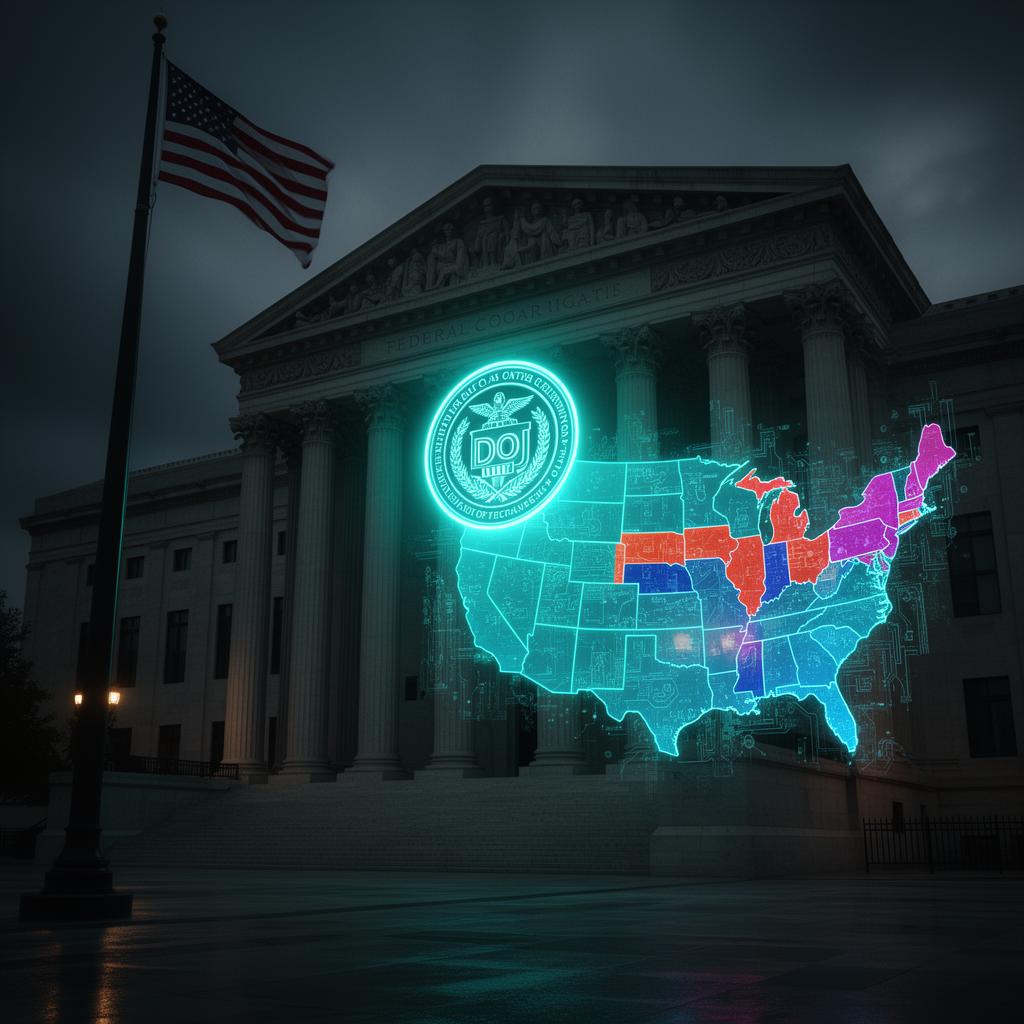
On January 9, 2026, Attorney General Pam Bondi formally announced the creation of the Department of Justice's Artificial Intelligence Litigation Task Force, a federal body with a singular and unprecedented mandate: to identify and legally challenge state-level AI laws that the administration considers inconsistent with national policy. The Task Force represents the sharpest edge of a broader federal strategy to centralize AI governance in the United States, and its implications for legal practitioners, technology companies, and state regulators are profound.
Here's what you need to know.
The Genesis: Executive Order 14365
The Task Force didn't emerge in a vacuum. It was directed by Executive Order 14365, signed by President Trump on December 11, 2025, titled "Ensuring a National Policy Framework for Artificial Intelligence." The Executive Order establishes as official U.S. policy the goal of sustaining American global AI dominance through what it calls a "minimally burdensome national policy framework."
The EO's language is blunt about its targets. It characterizes state-by-state AI regulation as creating a "patchwork of 50 different regulatory regimes" that makes compliance unnecessarily difficult—particularly for startups and emerging technology companies. The order singles out Colorado's AI Act by name, arguing that its prohibition on "algorithmic discrimination" could force AI models to produce inaccurate outputs to avoid differential treatment of protected groups.
Critically, the Executive Order does not itself preempt, repeal, or invalidate any state law. Instead, it sets in motion a sequenced series of federal agency actions designed to identify, evaluate, and ultimately challenge state AI regulations through litigation, funding restrictions, and legislative proposals.
Inside the Task Force: Structure and Authority
The Task Force is chaired by Attorney General Bondi herself, with the Associate Attorney General serving as vice chair. Its membership draws from across DOJ senior leadership, including representatives from the Office of the Deputy Attorney General, the Office of the Solicitor General, and the Civil Division. This is not a study group or advisory panel—it is a litigation unit staffed with the DOJ's top appellate and civil litigators.
The Task Force's legal toolkit is expansive. According to Bondi's internal memorandum, it will challenge state AI laws on grounds including unconstitutional regulation of interstate commerce (the Dormant Commerce Clause), preemption by existing federal regulations, and any other basis the Attorney General deems appropriate. That final catch-all provision gives the DOJ extraordinary discretion in selecting both targets and legal theories.
The Task Force also operates in coordination with the Department of Commerce and consults regularly with David Sacks, the White House's Special Advisor for AI and Crypto, as well as senior White House policy officials, on which specific state laws warrant federal challenge.
The Commerce Department's Evaluation: The March 11 Deadline
A pivotal piece of this puzzle is the Commerce Department's evaluation of state AI laws, which was due yesterday—March 11, 2026. Under Section 4 of the Executive Order, Commerce Secretary Howard Lutnick was directed to publish a comprehensive assessment identifying state AI laws deemed "onerous" and in conflict with federal policy.
The evaluation's scope is significant. It must flag, at minimum, state laws that require AI models to alter their outputs and laws that compel disclosures or reporting in ways the administration considers violative of the First Amendment. The evaluation will also identify laws appropriate for referral to the Task Force—effectively serving as a target list for federal litigation.
Members of Congress have already weighed in. In February, Representatives Gabe Evans of Colorado and Nick Langworthy of New York wrote to Secretary Lutnick urging the inclusion of Colorado's AI Act and New York's RAISE Act in the evaluation. The universe of potentially affected laws extends well beyond those two, encompassing California's Transparency in Frontier AI Act (SB 53), California's Generative AI Training Data Transparency Act (AB 2013), and the rapidly growing body of state deepfake and algorithmic accountability legislation.
The Legal Theories: Dormant Commerce Clause and Federal Preemption
For practitioners, the legal architecture of the anticipated challenges deserves close attention.
The Dormant Commerce Clause
The primary weapon in the Task Force's arsenal—the constitutional principle that prohibits states from enacting legislation that improperly burdens or discriminates against interstate commerce. The administration's argument is straightforward: because frontier AI models are developed and deployed by companies operating on a national and global scale, a patchwork of divergent state requirements creates an unconstitutional burden on interstate commerce.
Federal Preemption
The argument that existing federal statutes and regulations already occupy the field, displacing state authority to regulate. This theory faces a more difficult road. Federal preemption typically flows from congressional enactments, not executive orders. As of today, there is no comprehensive federal AI statute on the books. The only standalone federal law substantively regulating AI systems is the TAKE IT DOWN Act, signed in May 2025, which addresses non-consensual intimate imagery including AI-generated deepfakes.
Without broader legislation, preemption arguments will need to rely on existing regulatory frameworks from agencies like the FTC, FCC, and SEC—a legally uncertain path.
The Executive Order also directs parallel actions to strengthen the federal hand. The FTC has been directed to issue a policy statement clarifying how the FTC Act applies to AI, particularly regarding state laws that the administration characterizes as requiring alteration of "truthful outputs." The FCC has been directed to initiate proceedings on a federal AI reporting and disclosure standard that could preempt conflicting state requirements.
What the Task Force Has Not Done—Yet
As of today, the Task Force has not filed a single lawsuit. This is by design. The Executive Order contemplates a sequenced process: Commerce identifies target laws, the Task Force evaluates legal theories, and then litigation commences.
Analysts widely expect Colorado's AI Act—with its effective date of June 30, 2026—to be among the first targets. New York's RAISE Act, signed by Governor Hochul on December 19, 2025, just days after the Executive Order, is another likely early target. California's multiple AI transparency and frontier model laws round out the probable initial docket.
Legal observers anticipate the first complaints could be filed in the coming weeks, potentially reaching federal appellate courts by late 2026 and the Supreme Court by 2027.
The Funding Lever: BEAD Program Conditions
The litigation strategy doesn't stand alone. The Executive Order also directs the Commerce Department to condition billions of dollars in broadband infrastructure funding—specifically, remaining allocations under the $42.45 billion Broadband Equity, Access and Deployment (BEAD) program—on states avoiding "onerous" AI laws. Nondeployment funds, which support everything from AI infrastructure to cybersecurity and telehealth, could be withheld from states with AI regulatory frameworks flagged in the Commerce evaluation.
This is a significant economic lever. It creates a powerful incentive for states to either repeal or refrain from enforcing their AI regulations—regardless of whether the DOJ's legal challenges succeed in court.
The Carve-Outs: What's Not in the Crosshairs
The Executive Order explicitly excludes several categories of state regulation from its preemption framework. State laws addressing children's safety, AI computing and data center infrastructure (excluding permitting), and state government procurement and use of AI are carved out. This suggests that laws like California's Companion Chatbots Act (SB 243), which mandates safety protocols for minors, are unlikely targets—though the precise boundaries of these carve-outs remain to be tested.
What This Means for Practitioners
For attorneys advising clients on AI compliance, the current moment is defined by uncertainty. State laws remain fully enforceable unless and until a court invalidates them or Congress enacts preemptive federal legislation. But the trajectory is clear: the federal government is building the infrastructure to challenge the most significant state AI regulations simultaneously.
Practitioners should be doing three things right now:
Continue Complying with Existing State AI Laws
Until courts rule otherwise, these laws carry the full force of law. Companies that relax compliance efforts based on the Executive Order alone are assuming substantial risk.
Map Obligations Against the Target List
If your clients operate under Colorado's AI Act, New York's RAISE Act, California's SB 53, or similar frameworks, those obligations may be subject to federal challenge in the near term. Build compliance programs that can flex—capable of scaling up or down as the legal landscape shifts.
Watch the Commerce Evaluation Closely
The report due this week will define the initial battlefield. Which laws Commerce identifies as "onerous" will determine where the Task Force focuses its resources and which industries feel the impact first.
The Bigger Picture
The DOJ AI Litigation Task Force is more than a legal mechanism. It represents a fundamental policy choice about how the United States will govern artificial intelligence. The administration has bet that centralized, minimal regulation is the path to maintaining America's competitive edge against China and other global rivals.
Critics—including governors in California, Colorado, and New York who have vowed to defend their state laws—argue that this approach sacrifices consumer protection, algorithmic accountability, and civil rights at the altar of innovation speed. Advocacy organizations like the ACLU have pushed back, while industry groups like the Consumer Technology Association have applauded the move.
Wherever you fall on that spectrum, the practical reality is this: we are entering a period of sustained federal-state litigation over AI governance that will define the regulatory landscape for a generation. The cases that emerge from the Task Force's work will establish foundational precedent on the Dormant Commerce Clause, federal preemption, and the constitutional boundaries of state technology regulation.
Every practitioner working at the intersection of law and technology should be watching this space. The rules of the game are being written right now.
Key Timeline

Matt Mishak, Esq.
Matt Mishak is the founder and CEO of LegalTek.ai LLC (d/b/a SilverTung), an AI-powered legal document automation platform for Ohio domestic relations practitioners. He is the Managing Attorney of Mishak Law LLC and serves as Law Director for the Village of South Amherst, Ohio.