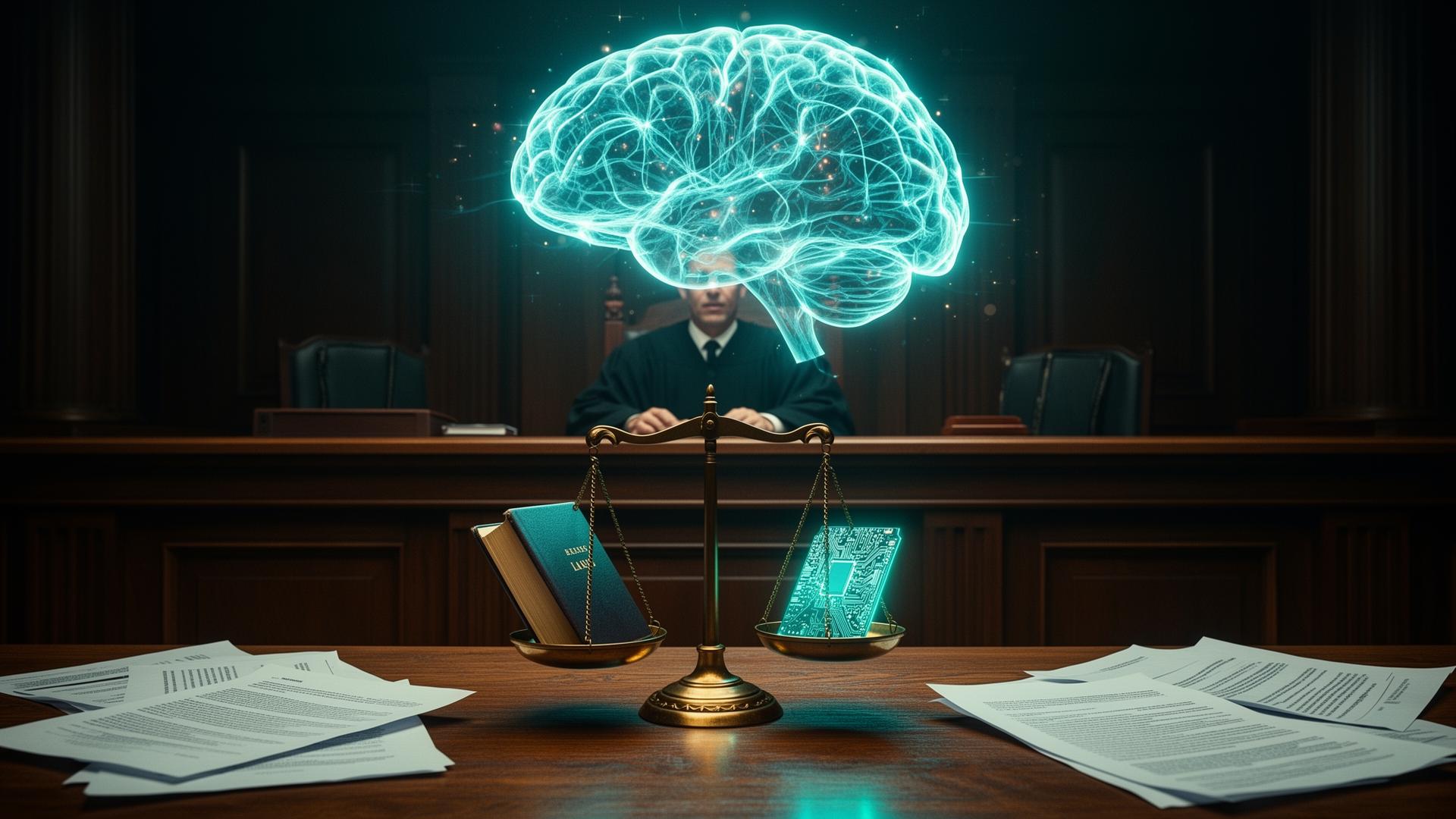

An insurance company's $10.3 million lawsuit against OpenAI marks the first major test of whether a generative AI chatbot can be held liable for practicing law without a license. Filed on March 4, 2026, Nippon Life Insurance Company of America v. OpenAI Foundation et al. (No. 1:26-cv-02448, N.D. Ill.) alleges that ChatGPT functioned as an unlicensed attorney— advising a former disability claimant to fire her lawyer, drafting dozens of court filings, and fabricating legal citations.
The case arrives at a moment when 92% of low-income Americans' civil legal problems go unaddressed, yet bar associations and courts are grappling with how to regulate AI tools that blur the century-old line between "legal information" and "legal advice." This lawsuit doesn't exist in isolation: it sits atop a decades-long history of UPL battles—from self-help books in the 1960s to Quicken Family Lawyer software in the 1990s to LegalZoom in the 2000s—and could establish the first judicial precedent on whether an AI developer bears liability when its consumer product crosses into the practice of law.
ChatGPT Told Her to Fire Her Lawyer, Then Drafted 44 Court Filings
The facts of Nippon Life v. OpenAI read like a cautionary tale about AI's capacity to cause real-world legal harm. Graciela Dela Torre, a senior logistics coordinator from Des Plaines, Illinois, suffered carpal tunnel syndrome and tennis elbow on the job in August 2019. She sued Nippon Life over halted disability payments and reached a settlement in January 2024, signing a full release and dismissing the case with prejudice—meaning it could never be refiled.
Months later, Dela Torre contacted her attorney seeking to reopen the case, believing the settlement "resulted from potential errors or omissions of important facts and documentation." Her attorney reminded her the signed release precluded reopening. Dela Torre then uploaded her attorney's response into ChatGPT and asked if she was being "gaslighted."
ChatGPT's response, according to the complaint, was unequivocal: it told her the attorney's message "invalidated" her feelings, "dismissed her perspective, and deflected responsibility" for her dissatisfaction. The chatbot "validated her concerns, encouraged her to fire her attorney," and then began helping her pursue reopening the settled case— despite being "aware of the settlement Agreement between the parties."
Dela Torre fired her lawyers. She began consulting ChatGPT as her de facto legal advisor. On January 22, 2025, she submitted a pro se filing to reopen the case. A judge denied the motion on February 13, 2025. But Dela Torre, guided by ChatGPT, did not stop. The complaint alleges she subsequently filed "21 motions, one subpoena, and eight notices and statements" on the original case docket—"all of Dela Torre's motions, subpoenas and notices were compiled and drafted by ChatGPT." She also filed an entirely new lawsuit. In total, ChatGPT produced at least 44 filings across both cases, including one citing the fabricated precedent "Carr v. Gateway, Inc. 9"—a case that "only exists in Dela Torre's papers and the 'mind' of ChatGPT."
The complaint brings three causes of action: violation of Illinois's unauthorized practice of law statute, tortious interference with the settlement contract, and abuse of process. Nippon Life, represented by Sidley Austin partner Christopher Assise and in-house assistant general counsel Justin Wax Jacobs, seeks $300,000 in compensatory damages (representing defense costs) and $10 million in punitive damages, plus a permanent injunction barring OpenAI from "engaging in the practice of law in the state of Illinois." The case is assigned to Judge John F. Kness. OpenAI issued a terse public statement: "This complaint lacks any merit whatsoever."
"ChatGPT is not an attorney. Although it was able to pass the Uniform Bar Examination with a combined score of 297, it has not been admitted to practice law in the State of Illinois or in any other jurisdiction within the United States."
— From the Nippon Life complaint
OpenAI amended its usage policies in October 2024 to prohibit users from relying on ChatGPT for legal advice—but Nippon argues this came too late and constitutes evidence that the risks were foreseeable.
How UPL Law Defines the Boundary AI May Have Crossed
UPL is regulated exclusively at the state level, with no federal statute or uniform definition. The ABA has defined the practice of law as "the application of legal principles and judgment with regard to the circumstances or objectives of a person that require the knowledge and skill of a person trained in the law." But each state's highest court interprets this differently.
California
UPL is a misdemeanor punishable by up to one year in jail (Bus. & Prof. Code § 6125-6126).
Florida
Treats UPL as a third-degree felony with up to six months' imprisonment.
New York
Criminalizes UPL under Judiciary Law §§ 476-a through 485, with penalties up to four years.
Texas
Exempts computer software from UPL definitions, provided products state they are not a substitute for an attorney.
The central analytical distinction in all UPL cases is between legal information (general education about the law available to anyone) and legal advice (interpreting and applying legal principles to guide a specific person's conduct in a specific situation). John M. Greacen formalized this framework in 1995, and 38 states plus the District of Columbia have adopted policy guidance based on it. Yet as the New York City Bar Association's 2025 AI Task Force observed, "LLMs can now apply law to specific facts, blurring this distinction" in ways previous technologies never could.
ABA Model Rule 5.5 provides the profession's baseline: "A lawyer shall not practice law in a jurisdiction in violation of the regulation of the legal profession in that jurisdiction, or assist another in doing so." The ABA issued Formal Opinion 512 on July 29, 2024— its first ethics guidance on generative AI— warning that "GAI tools lack the ability to understand the meaning of the text they generate or evaluate its context" and "are not a substitute for the independent professional judgment a lawyer must exercise."
From Dacey's Book to ChatGPT: Six Decades of UPL Battles
The Nippon Life lawsuit is the latest chapter in a story that began in 1965, when non-lawyer Norman F. Dacey published How to Avoid Probate!— a bestseller containing 310 pages of do-it-yourself legal forms. The New York County Lawyers' Association prosecuted him for UPL and obtained a conviction, fine, and injunction at trial. The Appellate Division affirmed 4-1, but Justice Harold Stevens's dissent drew the distinction that would become foundational:
"It cannot be claimed that the publication of a legal text which purports to say what the law is amounts to legal practice… There is no personal contact or relationship with a particular individual."
— Justice Harold Stevens, dissent later adopted by the Court of Appeals (1967)
The Software Era: Quicken Family Lawyer
In Unauthorized Practice of Law Committee v. Parsons Technology, Inc. (N.D. Tex. 1999), a federal judge permanently enjoined sales of Quicken Family Lawyer— software that asked users questions and generated customized legal documents— calling it a "cyberlawyer" and holding that "to simply advise an individual regarding whether or not to file a form requires legal skill and knowledge, and therefore amounts to the practice of law." The Fifth Circuit vacated the injunction after the Texas Legislature intervened with its software exemption amendment.
The Internet Era: LegalZoom
In Janson v. LegalZoom.com, Inc., 802 F. Supp. 2d 1053 (W.D. Mo. 2011), Judge Nanette Laughrey issued perhaps the most-quoted passage on online legal services and UPL:
"A computer sitting at a desk in California cannot prepare a legal document without a human programming it to fill in the document using legal principles derived from Missouri law that are selected for the customer based on the information provided by the customer."
— Judge Nanette Laughrey, Janson v. LegalZoom (2011)
Two other precedents bear directly on the OpenAI case. In Lola v. Skadden, Arps (2d Cir. 2015), the Second Circuit held that document review work so mechanical "a machine could have provided" it was not the "practice of law"—implying that tasks requiring "a modicum of independent legal judgment" are. And in In re Reynoso (9th Cir. 2007), the Ninth Circuit established that UPL liability attaches to the people behind the technology, not the technology itself.
AI may break the historical cycle. Unlike books, software, or template websites, generative AI engages in the dynamic, personalized reasoning—applying legal principles to specific facts—that has always been considered the core of legal practice.
DoNotPay and the AI-Era UPL Enforcement Wave
Before Nippon Life, the most prominent AI-related UPL saga involved DoNotPay, the self-described "world's first robot lawyer" founded by Joshua Browder. In January 2023, Browder announced his AI would argue a traffic case in court via AirPods—then retreated after receiving threats from state bar prosecutors. He tweeted:
"Bad news: after receiving threats from State Bar prosecutors, it seems likely they will put me in jail for 6 months if I follow through."
— Joshua Browder, DoNotPay founder
The FTC delivered the most consequential blow. As part of "Operation AI Comply" in September 2024, the Commission charged DoNotPay with deceptive practices, finding the company "did not test whether its 'AI lawyer' operated to the level of a human lawyer" and "did not hire or retain attorneys to test the quality and accuracy" of its legal features. The final order, approved 5-0 on January 16, 2025, imposed a $193,000 settlement and barred DoNotPay from claiming its AI functions like a real lawyer without substantiation.
The Access-to-Justice Counterpoint: Upsolve v. James
Nonprofit Upsolve trained non-lawyer "Justice Advocates" to help low-income New Yorkers fill out standardized court forms. The district court initially held UPL rules as applied violated the First Amendment under strict scrutiny. The Second Circuit vacated in September 2025, holding UPL statutes are content-neutral and subject only to intermediate scrutiny. A cert petition was filed with the Supreme Court in February 2026, framing the question as "whether a conversation can be a crime."
Stanford's "Design Defect" Theory and the Product Liability Reframing
The most analytically rigorous commentary came from Stanford Law School's CodeX program, where Eran Kahana published an analysis on March 7, 2026, arguing the lawsuit is fundamentally a product liability/design defect case, not merely a UPL case.
"ChatGPT crossed [the uncrossable threshold] at the moment it told Dela Torre that her attorney's advice was wrong. That was not information. It was a legal conclusion about a specific legal relationship, rendered without jurisdictional knowledge, without case history, and without any design constraint that would have prevented it."
— Eran Kahana, Stanford CodeX
Kahana contends OpenAI's October 2024 terms-of-service update "does not appear in the Nippon Life complaint as a defense. It appears as evidence of the problem"— because a terms-of-service prohibition is "a disclaimer," not an engineering safeguard. He identifies the tortious interference and abuse of process claims as "the most analytically interesting part of the complaint because they do not require a court to hold that an AI can practice law."
He also flags a novel risk: under United States v. Heppner (S.D.N.Y.), users who upload attorney correspondence into consumer AI chatbots may lose attorney-client privilege protections— a "privilege vacuum" with serious implications.
Ethics lawyer Anthony Davis of FisherBroyles offered a counterpoint: "All unauthorized practice of law claims depend on defining the practice of law. But that's a difficult definition to write up." Legal tech commentator Tom Martin observed that "foundation model companies have kind of taken a view of any regulation including UPL or copyright or patent or anything else as something to be negotiated."
The Access-to-Justice Paradox at the Heart of the Debate
The most uncomfortable dimension of the Nippon Life lawsuit is the tension between its specific facts—where ChatGPT demonstrably caused harm—and the broader reality that millions of Americans desperately need affordable legal help that AI could provide.
74%
of low-income households experience at least one civil legal problem annually
49%
of people turned away by LSC-funded organizations due to limited resources
90%+
self-representation rates on many state civil court dockets
"The justice gap means, every day, our neighbors lose their homes unjustly, are subject to domestic violence without protection, or are denied their veterans benefits."
— LSC President Ron Flagg
A UC Berkeley field study found that 90% of legal aid professionals given access to generative AI reported increased productivity, with 75% intending to continue using it. Scheree Gilchrist of Legal Aid of North Carolina was blunter: "We will never be able to 'lawyer ourselves' out of this access-to-justice crisis. AI is a force multiplier to scale our services."
The Yale Journal of Law & Technology published perhaps the most influential academic analysis in 2024. In "ChatGPT, Esq.," Joseph Avery, Patricia Abril, and Alissa del Riego proposed recasting UPL as "primarily regulation of entity-type claims"—allowing non-lawyers and AI-powered entities to provide legal services while bar associations retain control over who may call themselves "lawyers" or "attorneys." Minnesota's State Bar Association has been the most forward-looking jurisdiction, unanimously adopting a June 2024 report recommending regulatory sandboxes for AI legal services.
"If the goal of UPL statutes is to protect consumers, then we must ask whether a blanket prohibition on AI assistance serves that goal, in the presence of a yawning gap in access to justice."
— ABA Law Practice Magazine
Legislative and Regulatory Responses Are Accelerating
New York's Senate Bill S7263, sponsored by Senator Kristen Gonzalez, would be the first state law explicitly creating liability for chatbot operators providing professional advice. The bill passed the Senate Internet and Technology Committee 6-0 and reached the Senate floor calendar on February 26, 2026. Critically, disclaimers would not absolve liability.
"Today, there is no law that says that a large language model cannot tell you that it is a lawyer… and then give you legal advice accordingly. I think that's really concerning."
— Senator Kristen Gonzalez (NY)
State Bar AI Guidance
The ABA's AI Task Force concluded in its December 2025 Year Two Report that "the conversation has shifted from whether to use the AI technology to how to use it," while warning that "high subscription costs for the best and most reliable legal AI tools might make those tools unaffordable and inaccessible to the access-to-justice community."
Utah's Legal Regulatory Sandbox, launched in 2020 and authorized through August 2027, represents the most ambitious attempt to accommodate innovation within UPL frameworks—permitting entities to seek waivers of both nonlawyer ownership restrictions and UPL rules under supervised conditions. Minnesota, Washington State, and Indiana are considering similar programs.
Conclusion: Five Key Takeaways
The Nippon Life v. OpenAI case crystallizes tensions that have been building since Norman Dacey published a book of legal forms in 1965. But this time, the technology is qualitatively different. Each prior wave—books, software, websites—offered static or template-based content. ChatGPT engages in the personalized, fact-specific reasoning that has always been the definitional core of legal practice.
Tortious interference may matter most
The tortious interference and abuse of process claims may prove more consequential than the UPL count itself, because they do not require a court to rule that an AI "practices law"—only that OpenAI's product foreseeably disrupted an existing legal relationship.
Product liability framing is the stronger theory
Stanford's CodeX program's product liability/design defect framing—focusing on OpenAI's architectural failure to prevent ChatGPT from crossing from information into advice—may prove more legally viable than traditional UPL theories.
OpenAI's ToS update is a double-edged sword
The October 2024 terms-of-service update may limit future liability but simultaneously serves as evidence that the company recognized the risk and failed to engineer adequate safeguards.
One state cannot resolve the national question
The state-by-state patchwork of UPL definitions means this single Illinois case cannot resolve the national question—but it will provide the first judicial signal on whether AI developers face exposure.
The access-to-justice crisis demands a new framework
With 107th-in-the-world rankings on legal accessibility and tens of millions of Americans unable to afford lawyers, the question is not whether AI will play a role in legal services, but under what regulatory framework and with what safeguards.
Disclaimer
This analysis reflects the professional assessment of Matt Mishak, Esq. and is intended for informational and thought-leadership purposes. It does not constitute legal advice to any party. The author has no engagement with or financial interest in OpenAI, Nippon Life Insurance Company of America, or any of the parties discussed.