

Matthew M. Mishak, Esq.
Managing Attorney, Mishak Law LLC | Founder & CEO, LegalTek.ai LLC (d/b/a SilverTung)
Abstract
The rapid proliferation of AI-powered legal technology platforms has created a paradox: it has never been easier to launch a legal AI product, and it has never been harder to build one that endures. As foundation models from OpenAI, Anthropic, and Google commoditize the raw cognitive capabilities underlying legal analysis, the critical question for legal technology companies shifts from whether they can build an effective product to whether they can build a defensible one. This article proposes a five-level framework—the Legal AI Value Stack—for analyzing where durable competitive advantage resides in the legal AI ecosystem. Drawing on emerging market data, economic analysis of vertical AI companies, and observed patterns among leading platforms such as Harvey, Eve Legal, CoCounsel, Clio, and BriefPoint, this article argues that defensibility in legal AI is not a function of model sophistication but of structural positioning within the value chain.
1. The Defensibility Crisis in Legal AI
The legal technology sector is undergoing its most significant transformation since the digitization of case law databases in the 1990s. Artificial intelligence, and specifically large language models, have demonstrated remarkable capacity for tasks long considered the exclusive province of trained attorneys: statutory analysis, contract review, legal research, document drafting, and even preliminary case evaluation. Industry estimates project that the global legal AI market will exceed $4 billion by 2027, with adoption rates among AmLaw 200 firms already approaching saturation for basic AI-assisted research tools.
Yet beneath the surface of this adoption wave lies a structural vulnerability that most market participants have failed to confront. The very capabilities that make legal AI products valuable—natural language understanding, contextual reasoning, document generation—are increasingly provided by a small number of foundation model providers. A company that builds its product atop GPT-4 simultaneously becomes harder to distinguish from its competitors.
This dynamic creates what might be termed a defensibility crisis: the more capable foundation models become, the more difficult it becomes for application-layer legal AI companies to maintain pricing power, customer loyalty, or competitive separation. A legal brief that once required a proprietary fine-tuned model can now be competently drafted through a carefully prompted commercial API call. The question confronting every legal AI founder, investor, and enterprise buyer is therefore not whether AI can perform legal tasks—that question is settled—but where in the value chain sustainable competitive advantage actually resides.
2. The Legal AI Value Stack: A Five-Level Framework
The Legal AI Value Stack is structured as an ascending hierarchy. Each successive level represents a deeper, more structurally embedded form of competitive advantage. Companies operating exclusively at lower levels face constant commoditization pressure; those that ascend through the stack build compounding advantages that become progressively more difficult for competitors to replicate.
Regulatory-Ethical Moats
Highest — Compliance frameworks, trust certifications, bar-approved governance create institutional lock-in
Example: COUNSEL/G3M governance; bar-certified AI audits
Outcome Intelligence
Very High — Predictive models trained on proprietary outcome data compound with scale
Example: Eve Legal case evaluation; Harvey institutional knowledge
Proprietary Data Accumulation
High — Usage generates unique datasets unavailable to competitors
Example: Eve Legal (plaintiff case outcome data)
Workflow Integration
Moderate — Switching costs from deep CMS/PMS embedding create friction
Example: Clio Duo, CoCounsel (integrated into Westlaw)
Foundation Model Access
Low — Easily replicated; dependent on upstream provider pricing
Example: Generic GPT wrapper for legal Q&A
Level 1: Foundation Model Access
At the base of the stack sit companies whose primary value proposition is providing attorneys with access to large language model capabilities through a legal-specific interface. These products typically consist of a user interface wrapped around API calls to commercial models—GPT-4, Claude, Gemini—with legal-specific prompting, citation formatting, or jurisdiction-aware instructions layered on top.
The economic challenge at this level is severe. Foundation model providers engage in aggressive price competition: API costs have fallen by roughly an order of magnitude over the past eighteen months, and each new model generation delivers substantially more capability per dollar. A company whose competitive advantage resides primarily in prompt engineering and UI design faces a relentless treadmill. Every improvement to the underlying model narrows the gap between the specialized product and a general-purpose chatbot.
Level 2: Workflow Integration
The second level represents a meaningful increase in defensibility. Companies operating at Level 2 have embedded their AI capabilities into the daily operational workflows of law firms and legal departments. Rather than functioning as standalone tools to which attorneys must context-switch, these products become indistinguishable from the practice management software, document management systems, and case management platforms that attorneys already inhabit.
Thomson Reuters' integration of CoCounsel into the Westlaw research environment exemplifies this strategy. An attorney conducting research in Westlaw encounters AI-assisted analysis as a seamless extension of a platform they already use daily. The switching cost is not the AI capability itself—another research tool could provide comparable outputs—but the disruption of migrating an entire research workflow to a new platform. Clio's deployment of AI features within its practice management suite creates similar dynamics.
The limitation of Level 2 is that workflow integration, while creating meaningful switching costs, does not generate compounding advantages. A competitor with sufficient engineering resources and market patience can build comparable integrations.
Level 3: Proprietary Data Accumulation
Level 3 marks the transition from defensive positioning to offensive advantage. Companies operating at this level generate proprietary datasets through the normal course of product usage—datasets that are unavailable to competitors and that become more valuable with each additional user interaction.
The case of Eve Legal, a plaintiff-side legal AI platform that recently achieved a one-billion-dollar valuation, illustrates this dynamic with unusual clarity. Eve processes over two hundred thousand legal cases annually across more than four hundred and fifty law firm clients, with one hundred percent of cases at client firms flowing through the platform.
The Data Flywheel
This data is structurally proprietary. Foundation model providers cannot access it through web scraping or public data collection. Competitors cannot replicate it without achieving comparable market penetration. And critically, the dataset grows more valuable with each case processed—creating the compounding data flywheel that distinguishes Level 3 companies.
Level 4: Outcome Intelligence
Level 4 represents the conversion of accumulated proprietary data into predictive intelligence that fundamentally alters the economic calculus of legal practice. Where Level 3 companies collect data, Level 4 companies deploy that data to generate insights that create new forms of economic value.
Tool vs. Infrastructure
A tool helps attorneys do existing work faster. Infrastructure expands what work is economically possible. Eve's platform enables attorneys to profitably serve $5,000 cases that were previously uneconomic at $50,000 thresholds—expanding the addressable market rather than merely optimizing the existing one.
The outcome intelligence layer creates a defensibility profile that is qualitatively different from anything below it. A competitor can replicate a user interface, reverse-engineer a workflow integration, or even assemble a comparable raw dataset given enough time and market penetration. But outcome intelligence requires not only the data but the accumulated model training, validation, and refinement that transforms raw case data into reliable predictive signals. This temporal dimension creates what one analyst has described as "a moat measured in time multiplied by reinforcement learning signal quality."
Level 5: Regulatory-Ethical Moats
The highest level of the Legal AI Value Stack exploits a feature unique to the legal profession: the dense regulatory environment governing the practice of law. Unlike technology, finance, or healthcare—where regulatory requirements are imposed externally by government agencies—the legal profession is self-regulating, with state bar associations exercising direct authority over the tools, methods, and standards that attorneys may employ.
The ABA's Model Rules of Professional Conduct impose specific obligations on attorneys regarding competence (Rule 1.1), confidentiality (Rule 1.6), and supervisory responsibilities (Rules 5.1–5.3) that apply directly to the use of AI tools in legal practice. An AI platform that can demonstrate verifiable compliance with these obligations—through documented audit trails, explainable outputs, certified data handling procedures, and governance frameworks mapped to specific rule requirements—creates a regulatory moat that no amount of technical capability can circumvent.
This level represents the convergence of technology and institutional trust. A bar association that certifies a specific AI platform as compliant with professional conduct obligations creates an institutional endorsement that competitors must independently earn. The legal AI companies that invest in building verifiable governance frameworks—mapping AI operational checkpoints to specific ABA Model Rules, operationalizing the NIST AI Risk Management Framework for legal contexts, maintaining cryptographic audit trails for every AI-generated output—will occupy a competitive position that is structurally reinforced by the very regulatory apparatus that governs the profession.
3. Economic Dynamics Across the Stack
3.1 The Differentiation-Defensibility Distinction
The most consequential analytical error in legal AI evaluation is the conflation of differentiation with defensibility. Differentiation is what makes a product better than alternatives today: superior natural language understanding, more accurate citation, faster document generation. Defensibility is what makes a product resistant to displacement tomorrow: proprietary data assets, embedded workflows, regulatory certifications, and compounding network effects.
⚠️ The Critical Insight
Most legal AI companies are currently differentiated. Very few are defensible. A company with strong differentiation but weak defensibility will enjoy initial market traction followed by margin compression as competitors replicate its features.
3.2 The Toll Booth vs. Cult Dynamic
An instructive contrast emerges between two models of legal AI adoption. Certain platforms have created fervent user enthusiasm—what might be characterized as cult-like adoption—where attorneys express strong emotional attachment to the tool. Harvey's penetration of BigLaw demonstrates this pattern: associates reportedly celebrated when access was expanded to their level.
On the other hand, platforms like Eve Legal have built what amounts to a toll booth: a piece of infrastructure so deeply embedded in the economic logic of practice that attorneys cannot afford to operate without it. Cult dynamics depend on continued perceived superiority—inherently vulnerable to the next impressive demo. Toll booth dynamics depend on structural economic dependence—reinforced every time the attorney relies on the platform.
"Cult" Model
Levels 1–2
Emotional attachment, demo-driven. Vulnerable to next competitor.
"Toll Booth" Model
Levels 3–5
Structural dependence, economic necessity. Self-reinforcing.
3.3 Token Economics and Margin Structure
Most legal AI companies pay per-token costs to foundation model providers, creating a cost structure that scales with usage. Companies operating at higher levels of the Value Stack escape this dynamic by decoupling their value proposition from token consumption. A platform that charges for leverage—the ability to profitably serve cases that would otherwise be uneconomic—captures value proportional to the economic expansion it enables, not the tokens it consumes. This creates margin structures that improve with scale, in contrast to the flat or compressing margins experienced by Level 1 and Level 2 companies.
4. Implications for Legal Practitioners and Stakeholders
4.1 For Law Firm Decision-Makers
Attorneys evaluating AI platforms should assess prospective vendors against the Value Stack framework rather than relying primarily on feature comparisons or demo impressions. A platform that operates exclusively at Level 1 may deliver immediate productivity gains but creates vendor risk: the platform may be commoditized or discontinued as market dynamics evolve. Platforms that demonstrate clear strategies for ascending the stack represent more durable technology partnerships.
4.2 For Legal Technology Founders and Investors
The Value Stack framework suggests that the most valuable legal AI companies will be those that execute a deliberate ascent strategy: entering the market with differentiated capabilities (Level 1), embedding into workflows (Level 2), designing for proprietary data accumulation from day one (Level 3), investing in predictive model development as data assets mature (Level 4), and proactively building governance and compliance infrastructure (Level 5). Critically, the framework suggests that companies cannot skip levels.
4.3 For the Organized Bar and Regulators
State bar associations face a consequential choice. They can treat AI adoption as a risk to be managed through prohibitory rulemaking—an approach that will slow adoption without preventing it—or they can develop affirmative certification frameworks that establish clear standards for responsible AI use in legal practice. The latter approach would create the institutional infrastructure described at Level 5, simultaneously protecting the public interest and enabling the development of more defensible, trustworthy legal AI platforms.
5. Conclusion
The legal AI market is entering a phase of competitive maturation in which the distinction between differentiation and defensibility will determine which companies survive and which are displaced. The Legal AI Value Stack provides a structural framework for analyzing where durable competitive advantage resides—not in model sophistication or feature velocity, but in the depth of workflow integration, the accumulation of proprietary data assets, the development of predictive outcome intelligence, and the construction of regulatory-ethical moats that leverage the legal profession's unique self-regulatory structure.
"The moat is not the model. The moat is time, compounded by data, reinforced by trust."
References
American Bar Association. Model Rules of Professional Conduct (2024 ed.).
Conikee, C. "The AI Value Stack: Where Trillions Will Be Made and Lost." Beyond Boundaries (Substack), June 27, 2025.
Conikee, C. "The Revenue Trap: When AI Differentiation Masquerades as Defensibility." Beyond Boundaries (Substack), January 23, 2026.
Conikee, C. "The Tinker's Cult: How Tools Create Religious Followings." Beyond Boundaries (Substack), 2025.
Eve Legal. Company website and public disclosures. https://www.eve.legal (accessed March 2026).
Gartner. "Predicts 2026: AI Agent Adoption and Organizational Impact." 2025.
May, R. "The New White Collar Moat in AI." Investing in AI (Substack), March 2026.
McKinsey & Company. "The State of AI in 2025." McKinsey Global Survey, 2025.
NIST. AI Risk Management Framework (AI RMF 1.0). U.S. Department of Commerce, January 2023.
Ohio Supreme Court. Ohio Rules of Professional Conduct (2024 ed.).
Perez, E. "Defensibility in the Age of AI: Five Attributes Every Vertical Startup Needs." Medium, September 2025.
Swaroop, P. "You Just Raised $5M to Build Someone Else's Moat." Substack, March 2026.
Thomas, A. "Data and Defensibility." Abraham Thomas, 2023.
TrustArray / Relativity. "The AI & Legal Tech Forecast 2026." March 2026.
Essential Reading for the AI Era
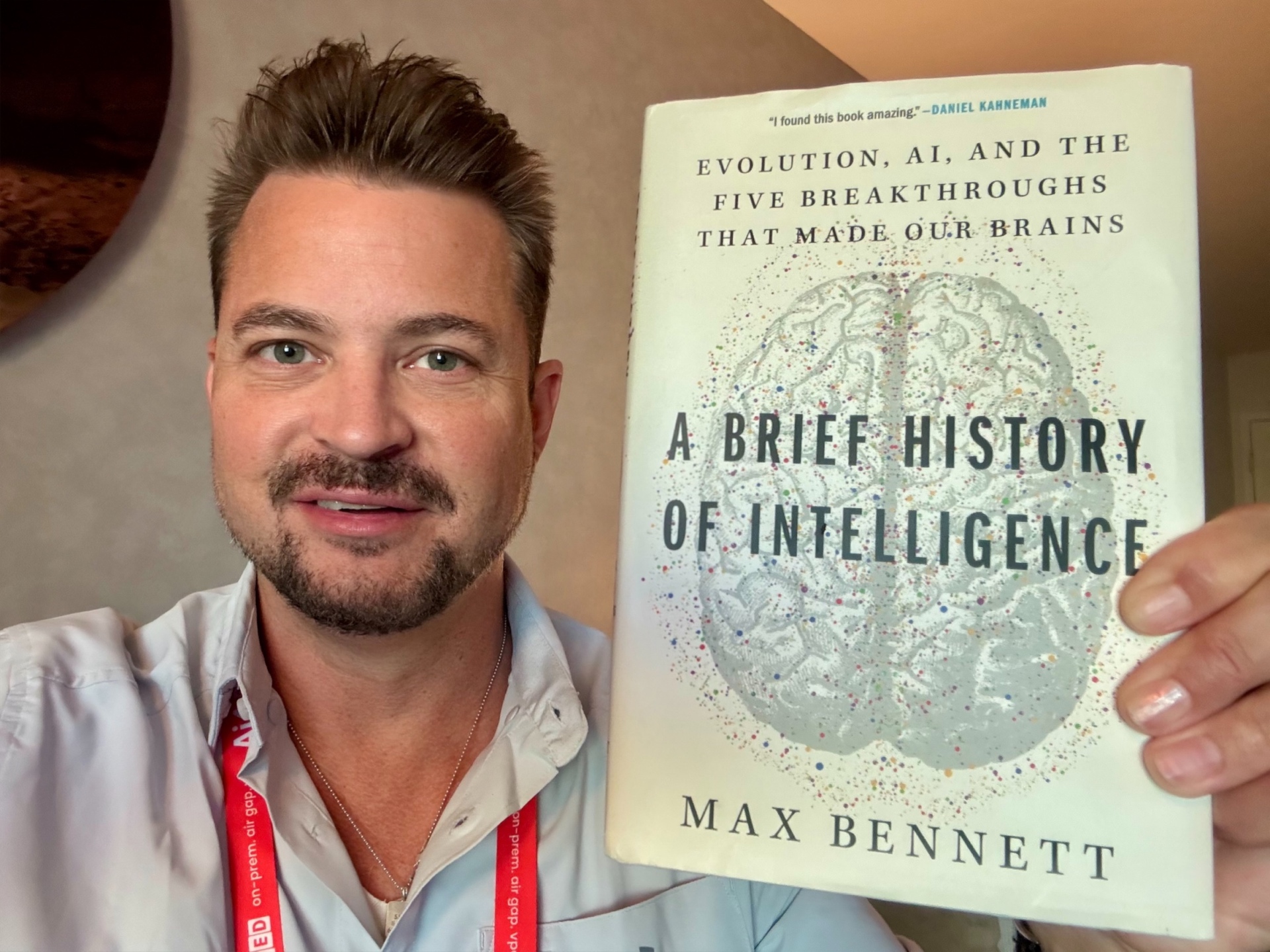
A Brief History of Intelligence
by Max Bennett
For me, A Brief History of Intelligence wasn't just another science book — it was the most inspiring read of 2025. Max Bennett doesn't merely explain evolution and AI; he illuminates the arc of our cognitive journey from the simplest organisms to the complex minds we carry today and links that journey to the future of artificial intelligence in a way few authors have managed.
Reading this book felt like a conversation with a brilliant guide who makes both neuroscience and AI feel vivid, urgent, and deeply meaningful. As someone immersed in law and technology, I found Bennett's insights not just informative but transformative — reminiscent of discussions at the Dartmouth Conference itself.
Praise from Visionaries
"I found this book amazing. I read it through quickly because it was so interesting, then turned around and read much of it again."
— Daniel Kahneman
Nobel Laureate in Economics
"I've been recommending A Brief History of Intelligence to everyone I know. A truly novel, beautifully crafted thesis on what intelligence is and how it has developed since the dawn of life itself."
— Angela Duckworth
Author of Grit

The Singularity Is Nearer
by Ray Kurzweil
Ray Kurzweil is not just a futurist — he's a prophet of exponential change. A student of Marvin Minsky, one of the founding minds behind the Dartmouth Conference, Kurzweil has been thinking about this moment longer than most institutions have been around.
If you don't know Ray Kurzweil, you should. The Singularity Is Nearer makes one thing clear: the future isn't coming slowly — it's arriving all at once.
Praise from Visionaries
"A fascinating exploration of our future, which raises the most profound philosophical questions."
— Yuval Noah Harari
Historian
"Ray Kurzweil is the greatest oracle of our digital age. The Singularity Is Nearer is more than just a book—it's a survival guide for the technological renaissance we're about to experience."
— Peter H. Diamandis, MD
Futurist & Entrepreneur

The Coming Wave
by Mustafa Suleyman & Michael Bhaskar
This isn't a hype book about shiny tools. It's a sober, urgent examination of what happens when powerful technologies scale faster than our institutions, laws, and social norms. Suleyman's core message is simple but uncomfortable: the future is not something that merely happens to us. It requires participation.
The coming wave of AI and biotechnology will not be safely "managed" by a small group of technologists or regulators alone. Containment, governance, and alignment demand broad engagement across professions, industries, and communities. Sitting on the sidelines is not a neutral position. Non-participation is still a choice, and usually a costly one.
What makes this book especially relevant for LegalTek.ai is its insistence that responsibility must scale with capability. Lawyers, operators, founders, and leaders cannot outsource judgment to systems or defer hard questions to later. The work is now: designing guardrails, rethinking institutions, and choosing to engage rather than react. Participation is the point.
Praise from Visionaries
"A fascinating, well-written, and important book."
— Yuval Noah Harari
Historian
"One of the most important books of the year. Suleyman is one of the few people who truly understands both the promise and peril of AI."
— Eric Schmidt
Former CEO of Google
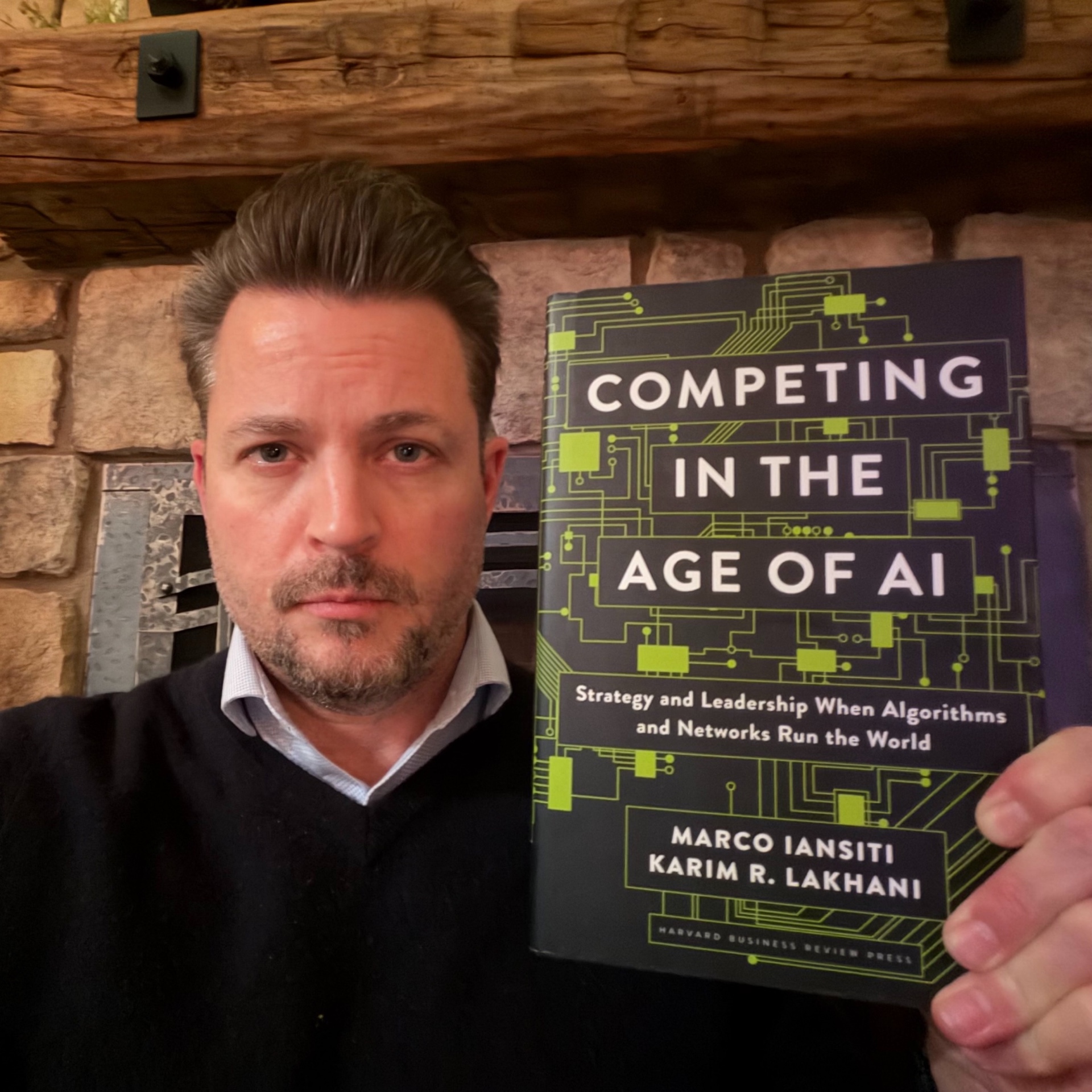
Competing in the Age of AI
by Marco Iansiti & Karim R. Lakhani
Marco Iansiti and Karim R. Lakhani's Competing in the Age of AI is not a book about tools. It is a book about power, structure, and survival in an economy where software, data, and algorithms increasingly define competitive advantage. The central thesis is simple but unsettling: companies do not become AI-powered by sprinkling models on top of legacy processes. They must reorganize themselves around AI as a core operating logic.
An AI-First organization treats data as infrastructure, not exhaust. Data lakes are not passive storage systems; they are living strategic assets continuously fed by operations, customers, and markets. The firms that win are those that design feedback loops where data improves models, models improve decisions, and decisions generate more data. This flywheel compounds faster than any traditional efficiency play.
The book is particularly sharp on disruption. AI does not merely automate tasks; it collapses coordination costs. Entire layers of management, intermediaries, and professional gatekeepers become vulnerable when prediction and decision-making move closer to real time. This is why AI-driven firms tend to scale faster, operate with fewer humans per dollar of revenue, and exert outsized pressure on incumbents.
Equally important is the authors' treatment of ethics and governance. AI systems embed values, whether intentionally or not. Bias, accountability, transparency, and trust are not compliance checkboxes; they are strategic concerns. Organizations that fail to govern AI responsibly risk regulatory backlash, reputational damage, and internal breakdowns of trust.
Why this matters for LegalTek.ai: law, regulation, and professional services are precisely the kinds of industries ripe for AI-driven reconfiguration. Firms that treat AI as a bolt-on tool will fall behind. Firms that rethink workflows, data ownership, trust, and human judgment alongside AI will define the next era. If you are building, advising, regulating, or investing in the future of legal and professional services, this book belongs on your desk.
Praise from Visionaries
"A compelling vision for how companies must transform to thrive in an AI-first world."
— Satya Nadella
CEO of Microsoft
"Essential reading for any leader trying to understand how AI will reshape industries and competitive dynamics."
— Reid Hoffman
Co-founder of LinkedIn

Nexus
by Yuval Noah Harari
Nexus by Yuval Noah Harari is a foundational text for anyone trying to understand how information systems shape power, institutions, and human behavior—especially as we enter an AI-driven era. Harari reframes history not as a story of tools or even ideas, but as a story of networks: who controls information flows, how trust is manufactured, and how coordination scales.
For LegalTek.ai, this book matters because law is itself an information network. Courts, statutes, contracts, evidence, compliance regimes, and now AI models are all nodes in a living system that governs behavior at scale. Harari makes one idea uncomfortably clear: technology does not just make systems faster—it reshapes who holds authority and how legitimacy is created.
He explores how information networks drift toward concentration, how automated decision systems can harden power asymmetries, and how societies repeatedly mistake efficiency for wisdom. These themes map directly onto modern legal technology questions around AI-assisted decision-making, automated compliance, algorithmic evidence, and the risk of opaque systems replacing human judgment.
Key insights: First, information systems always encode values—neutral tools do not exist. This reinforces the need for explicit governance, auditability, and human oversight in legal AI. Second, scale changes ethics—what works for a small network can become dangerous when automated and deployed broadly. Third, institutions lag technology—law historically reacts after power has already shifted.
Nexus supports a core LegalTek.ai principle: AI in law must be human-centered, transparent, and institutionally aware. The future of legal technology is not about replacing lawyers—it is about redesigning legal systems so that intelligence, whether human or artificial, serves fairness, legitimacy, and trust at scale. Highly recommended for anyone building, regulating, or relying on AI-driven legal systems.
Praise from Visionaries
"Harari has done it again. Nexus is a sweeping, thought-provoking exploration of how information has shaped human history—and how AI might reshape our future."
— Bill Gates
Co-founder of Microsoft
"A masterful synthesis of history, technology, and human nature. Essential reading for understanding where we're headed."
— Daniel Kahneman
Nobel Laureate in Economics

Supremacy
by Parmy Olson
Parmy Olson's Supremacy is the book I wish every lawyer, regulator, and founder would read before making their next move in AI. Winner of the Financial Times and Schroders Business Book of the Year 2024, this is not another breathless hype piece about what AI might do someday. It is a meticulously reported account of what has already happened — and what it means for power, competition, and control.
Olson, a Bloomberg columnist and author of We Are Anonymous, brings a journalist's rigor and a storyteller's instinct to the AI arms race between OpenAI and Google DeepMind. She traces how a small number of researchers, executives, and investors are making decisions that will reshape every industry on earth — including law. The central tension is not technical; it is human: ambition versus caution, open research versus commercial secrecy, safety versus speed.
What makes this book essential for LegalTek.ai readers is its unflinching examination of concentration risk. The foundation models that power legal AI products are controlled by a handful of companies. Olson documents how acquisitions, talent wars, and compute monopolies are narrowing the field in ways that should concern anyone building on top of these platforms. If you are a legal technology founder or an enterprise buyer evaluating AI vendors, this book provides the geopolitical and corporate context you cannot afford to ignore.
Supremacy reinforces a core LegalTek.ai principle: understanding AI is not optional for legal professionals. The race for AI supremacy is not happening in a vacuum — it is reshaping the infrastructure of knowledge work itself. Lawyers who understand the forces Olson describes will be better positioned to advise clients, evaluate tools, and navigate the regulatory landscape that is still being written.
Praise from Visionaries
"Astonishing... Olson has exclusive access to a network of high-level sources and she uses it to devastating effect."
— Financial Times
Business Book of the Year 2024
"A deeply reported, utterly gripping account of the most consequential technology race of our time."
— Tony Fadell
Creator of the iPod, Author of Build

Sapiens: A Brief History of Humankind
by Yuval Noah Harari
Sapiens is the book that rewired how I think about everything — law, technology, institutions, and human cooperation itself. Yuval Noah Harari doesn't just survey 70,000 years of human history; he dismantles the stories we tell ourselves about why civilization works. His central insight is deceptively simple: humans dominate the planet not because we are the smartest or strongest, but because we are the only species that can cooperate flexibly in large numbers — and we do it through shared fictions.
For anyone in law or legal technology, this idea should hit like a thunderbolt. Laws, contracts, corporations, courts, constitutions — these are all shared fictions. They work because enough people believe in them. Harari forces you to see the scaffolding behind the systems we take for granted, and once you see it, you cannot unsee it.
As AI begins to reshape how we create, interpret, and enforce these shared fictions, Sapiens becomes even more essential. If you want to understand where legal systems came from — and why they are so vulnerable to disruption — start here. This is the foundation that makes Nexus, The Coming Wave, and every other book on this list hit harder.
Praise from Visionaries
"Interesting and provocative... It gives you a sense of how briefly we've been on this earth."
— Barack Obama
44th President of the United States
"I would recommend this book to anyone interested in a fun, engaging look at early human history... You'll have a hard time putting it down."
— Bill Gates
Co-founder of Microsoft

How to Think About AI: A Guide for the Perplexed
by Richard Susskind
Richard Susskind has spent four decades thinking about the future of professional work, and How to Think About AI is the distilled vocabulary every lawyer needs for the decade ahead. This is not a tactical book about prompts or tools — it is a structured way of thinking about what AI is, what it is becoming, and what it implies for the institutions that depend on human judgment.
The chapter that most repays a careful read is Susskind's framing of the four long-run scenarios for the human–AI relationship: AI takeover, merger, peaceful coexistence, and shut-off. He treats each seriously, not as prediction but as the realistic shape of the possibility space. His argument is that any serious conversation about AI policy or professional practice has to hold all four open at once — and most public debate collapses prematurely into one.
For Ohio attorneys orienting around the COUNSEL Framework, this book pairs naturally with ABA Formal Opinion 512 and the Ohio Supreme Court's AI Task Force Report. The opinions tell you what your duties are. Susskind helps you decide what you believe about where the technology is headed — and that belief shapes every governance and oversight choice that follows.
Praise from Visionaries
"Susskind is the world's leading authority on the future of legal services and one of the most lucid writers on AI for non-specialists."
— The Times (London)
Review
"An indispensable guide for anyone who wants to think clearly about what AI means for their work, their profession, and their life."
— Daniel Susskind
Author of A World Without Work

The Book of Elon: Elon Musk's Most Useful Ideas, in His Own Words
by Eric Jorgenson (Foreword by Naval Ravikant)
Eric Jorgenson — the same curator who gave us The Almanack of Naval Ravikant — turns his method on Elon Musk. The Book of Elon is not a biography and not a hagiography. It is a disciplined distillation of Musk's own words on first-principles thinking, engineering, risk, capital, talent, and the long time-horizons required to build things that actually matter. Naval's foreword frames the through-line: patience compounds, and so does judgment.
For lawyers, founders, and operators in the AI era, the value here is not Musk-worship — it is method. First-principles reasoning is exactly the discipline the profession is going to need as AI collapses coordination costs and forces us to rebuild workflows, evidence standards, and governance from the ground up. This book belongs on the shelf next to Susskind and Bennett as a working manual for how to think when the ground is moving.
Praise from Visionaries
"Elon is the rare founder who operates from first principles at every layer of the stack — physics, engineering, capital, and time. This collection is the closest thing to a manual for how he thinks."
— Naval Ravikant
Founder, AngelList (from the Foreword)