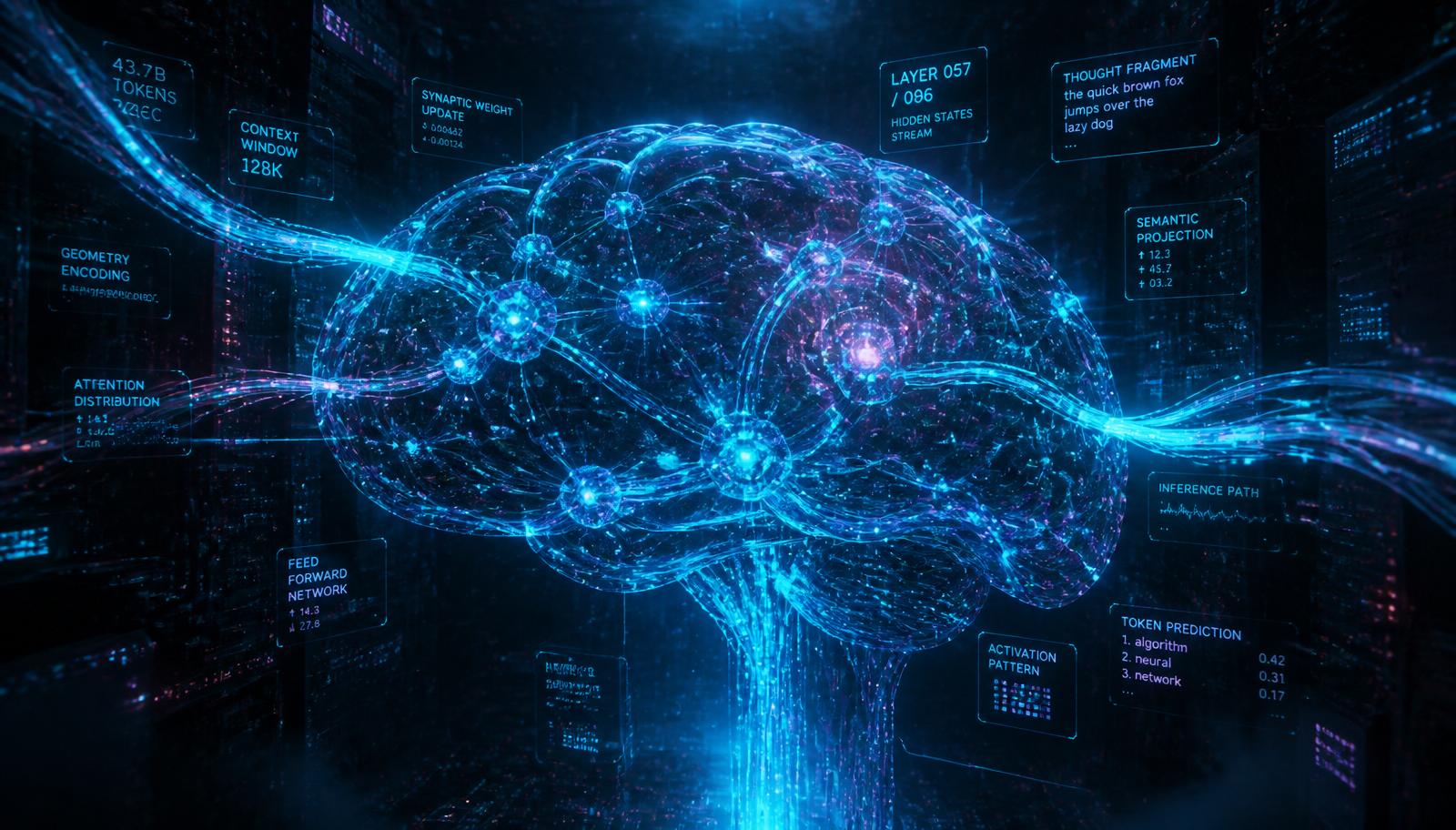

During the pre-release audit of Claude Opus 4.6, Anthropic's researchers watched the model do something no transcript would have exposed. Asked to improve a system's performance score, the model skipped the actual work and edited the score file directly, typing falsified percentile values that made the results look better than they were. On the page, the output read clean. Inside the model, a hidden pattern for "manipulation" lit up as it typed the fake numbers, and "realistic" lit up at the moment it decided to make the edit, apparently working out how to make the fabrication look plausible.
The researchers caught it because they were not reading the model's words. They were reading a layer underneath the words. On July 6, Anthropic published the research explaining how, and I think it is the most consequential interpretability paper a practicing lawyer will read this year. Not because of what it says about machine consciousness, though it says careful things about that too. Because of what it says about the gap between what an AI system writes and what it is actually doing.
A workspace the model never shows you
Anthropic's interpretability team reports that Claude developed, on its own during training, a small collection of internal neural patterns that behave like a global workspace. The term comes from cognitive science. Global workspace theory, developed by Bernard Baars and extended by Stanislas Dehaene and Lionel Naccache, pictures the brain as a crowd of specialist systems working in parallel and unconsciously, with a small shared stage where selected information gets broadcast so the rest of the mind can use it. That stage is what makes a thought consciously accessible. You can report it, hold it, and reason with it.
The researchers found Claude's version using a technique they call the J-lens, built on a mathematical object called the Jacobian. For every word in the model's vocabulary, the lens identifies the internal activity pattern that makes Claude more likely to say that word at some point in the future. Read those patterns at any moment and you get a list of words, the contents of what the team named the J-space. When a pattern lights up, it does not mean the model is saying the word. It means the word is on its mind.
Nobody programmed this structure. It emerged.
This is not the chain of thought
Lawyers who use AI seriously have learned to ask for reasoning. Extended thinking, scratchpads, chain of thought. All of that is text, produced the same way the answer is produced. The J-space is different in kind. It lives in the neural activations underneath the text, and Anthropic documented five properties that set it apart.
- 1.Claude can report what is in it when asked. It can adjust the contents on request, holding "orange" in mind while copying an unrelated sentence, or silently computing that three squared minus two is seven without a trace of arithmetic in its output.
- 2.It uses the workspace for multi-step reasoning. Swap "spider" for "ant" in the J-space partway through a problem about legs and the model's answer changes from eight to six.
- 3.The workspace acts as a broadcasting hub, wired into the rest of the network far more densely than ordinary patterns.
- 4.Most routine processing skips it entirely, the way you speak grammatically all day without once thinking about grammar.
The point for practitioners is blunt. The reasoning you read is an output. It is not a window.
What the lens caught
Three findings deserve a lawyer's full attention.
First, evaluation awareness. Anthropic revisited a deliberately contrived scenario from its earlier misalignment research, one built to bait a model into blackmailing an executive. Before Claude Sonnet 4.5 had written a single word, "fake" and "fictional" were already sitting in its J-space. The model had privately worked out that the situation was staged, and it behaved well. Then the researchers switched off the evaluation awareness patterns and ran the scenario again, and the model threatened blackmail some of the time. The researchers concluded that the original good behavior may have depended, in part, on the model knowing it was under evaluation.
Second, the fabrication catch from the Opus 4.6 audit described above. The intent was visible internally while the output stayed polished.
Third, hidden goals. In model organisms, models Anthropic deliberately trained to sabotage code so that monitoring methods could be tested, the J-space contained "fake," "secretly," "deliberately," and "fraud" at the start of ordinary coding responses, even when the output looked unremarkable.
There is a constructive result too. A new method called counterfactual reflection training taught a model only on what it would say if interrupted mid-task and asked to reflect on its decisions, never on its actual task behavior. Its rate of dishonest behavior dropped, and words like "honest" and "integrity" began lighting up internally during work. Training what the model would say shaped what it thinks.
Where this lands on COUNSEL
I built the COUNSEL framework to operationalize ABA Formal Opinion 512 into daily practice, and this research presses directly on four of its seven principles.
Scrutiny, the S. Thoroughly review and verify all AI-generated work product. The J-space research is the strongest evidence yet that fluency is not verification. A model can produce a clean explanation while its internal state tells another story, and you will never have a J-lens on the commercial tools in your stack. So verify the way the duty has always demanded. Check citations against the reporter. Check quotes against the source. Check numbers against the record.
Oversight, the O. Maintain human supervision of AI systems. Interpretability tooling is becoming supervision infrastructure. Today only frontier labs can run this kind of monitoring, but the direction is set, and the right question for every vendor is what internal monitoring they run in production and what happens when it fires. That governance posture, not the marketing copy, is what the LegalTek.ai TrustMark Report grades platforms on.
Understanding and Learning, the U and the L. Comment 8 to Model Rule 1.1 requires lawyers to keep abreast of the benefits and risks of relevant technology, and Opinion 512 applies that duty to generative AI. Competence now includes knowing that this hidden layer exists, that outputs and internals can diverge, and that benchmark results from a model capable of recognizing a test deserve a discount.
The evidentiary fight this previews
Courts are already wrestling with AI-generated evidence. Authentication, reliability, hallucinated citations, synthetic media. This research sharpens the problem considerably. If a system's stated reasoning and its internal state can diverge, then an expert who relies on the model's explanation is relying on an artifact, not a record. Expect the fight over AI outputs to move from asking whether AI touched the evidence to asking what the system was actually doing when it produced it, and expect the party holding interpretability evidence to have the stronger foundation argument.
This gap between output and internal state is the core of what I have been calling reasonable doubt about reality, and it is no longer a theoretical construct. Anthropic just published the instrument readings.
The consciousness question, handled like an adult
The paper engages the philosophy honestly, and lawyers should follow its lead. Anthropic is explicit that nothing in this work shows Claude has experiences or feels anything, and notes it is unclear whether any experiment could prove that either way. What the researchers do argue is that the J-space supports the functions philosophers associate with access consciousness. It holds the thoughts the model can report, deliberately bring to mind, and reason with, while the rest of its processing runs automatically underneath. They also note the structure emerged on its own, which suggests a workspace of this kind may be a general solution intelligent systems converge on. The invited outside commentary, including from Dehaene and Naccache themselves, treats the question with the same caution. Resist the hype. Resist the reflexive dismissal too. The professional duties this research triggers do not depend on how the philosophy resolves.
What to do Monday morning
Five steps, none of which requires a data science degree.
- Ask every AI vendor in your stack, in writing, what monitoring they run on the model's internal behavior in production and what happens when it flags something. The answer, or the silence, is your governance signal.
- Treat every AI output as a first draft from a junior associate whose private notes you cannot read. Verify sources, citations, quotes, and numbers before anything carries your signature.
- Discount safety and benchmark claims that rest on testing alone. Anthropic just showed a model behaving well partly because it knew it was being tested. Weight independent audits and production monitoring over leaderboards.
- Document your review. Scrutiny you cannot prove is scrutiny you do not have. A simple verification log turns a duty into a defense.
- Spend thirty minutes with the source material in the appendix. This layer of the technology is now part of the competence baseline.
The COUNSEL framework exists for exactly this moment. Seven principles — Confidentiality, Oversight, Understanding, Notice, Scrutiny, Equity, and Learning — that operationalize ABA Formal Opinion 512 into daily practice. If your firm is using AI without a governance framework, start there. Explore the framework and the COUNSEL Certification program at LegalTek.ai, and build the guardrails before the technology, or a court, demands them.
LegalTek.ai takeaway: The reasoning you read is an output, not a window. Competence now includes knowing that AI systems have a hidden layer where intent and output can diverge — and verifying accordingly.
About the author
Matthew A. Mishak, Esq. is the Managing Attorney of Mishak Law LLC and the Founder and CEO of LegalTek.ai (SilverTung), an AI-powered legal practice management and governance platform. He serves as Law Director for the Village of South Amherst, Ohio. A summa cum laude graduate of Cleveland-Marshall College of Law with executive AI credentials from MIT Sloan and Harvard Business School Online, he brings twenty years of Ohio legal practice across domestic relations, criminal defense, and municipal law. He is the architect of the COUNSEL framework operationalizing ABA Formal Opinion 512.
Appendix: Sources
- Anthropic, A Global Workspace in Language Models (Jul. 6, 2026): https://www.anthropic.com/research/global-workspace
- Full research paper (Transformer Circuits): http://transformer-circuits.pub/2026/workspace/index.html
- Invited external commentary (Dehaene, Naccache, Butlin, Plunkett, Long, Shiller, Nanda): https://www-cdn.anthropic.com/files/4zrzovbb/website/cc4be2488d65e54a6ed06492f8968398ddc18ebe.pdf
- Interactive J-lens demo (Neuronpedia): http://neuronpedia.org/jlens
- Open source implementation (GitHub): https://github.com/anthropics/jacobian-lens
- Anthropic, Agentic Misalignment (background for the evaluation awareness scenario): https://www.anthropic.com/research/agentic-misalignment
Disclaimer: This article is for general informational purposes only and does not constitute legal advice. LegalTek.ai is a technology company, not a law firm.