A legal brief dissolving into glowing fragments on a counsel table in a darkened Ohio courtroom, beside a gavel and a bar card
    AI Sanctions · Ohio Discipline

    The Fake Cases Were Only the Beginning: What Ohio Lawyers Should Learn From the Wilson Suspension

    Ohio did not suspend a lawyer for using AI. It sanctioned a failure to verify, a failure of candor, and a refusal to make it right.

    Matthew A. Mishak, Esq.November 26, 2026 11 min read
    Share

    It happened in our own bar

    On November 24, 2026, the Supreme Court of Ohio indefinitely suspended Cleveland attorney Arleesha Shawntay Wilson. The decision, Cleveland Metro. Bar Assn. v. Wilson, Slip Opinion No. 2026-Ohio-4626, was unanimous. Most of us first saw it as a headline about artificial intelligence inventing case law in a brief. That headline is true. It is also incomplete, and the missing part is the part every Ohio lawyer needs to understand.

    I practice in Lorain County, a short drive from the courthouse where this story began. I take no pleasure in writing about a colleague's discipline. Ms. Wilson was admitted in 2018 and practiced on her own in Cleveland. I am writing because the opinion is a clear map of how a verification failure becomes a candor problem, and how a candor problem becomes a license problem. Any of us who skips the checking step is closer to this record than we would like to believe.

    What the record shows about the AI brief

    The AI portion of the case grew out of a 2024 lawsuit Ms. Wilson filed for a security services company, Safe Choice, L.L.C., against the City of Cleveland in the Cuyahoga County Court of Common Pleas. The city removed the case to the U.S. District Court for the Northern District of Ohio. Wilson, 2026-Ohio-4626, ¶ 31. Ms. Wilson then filed a brief opposing the city's motion for judgment on the pleadings. Id. at ¶ 32.

    The city told the federal court that the brief attributed quotations to opinions that did not contain them and cited four cases that did not exist. The court ordered Ms. Wilson to produce the four cases or explain why she could not. She sent 1,395 pages of case law. The four cases were not among them. Id. at ¶ 33.

    At the contempt hearing in October 2025, she did not concede at first that the cases were fictitious. She offered three other decisions, which the court found came from different years or different courts, or carried slightly different names. Under the judge's questioning, she confirmed she had used AI to draft the brief and acknowledged she could not find the cases. Id. at ¶ 36. The federal court declined to hold her client in contempt but found Rule 11 violations, including reliance on the nonexistent cases and misrepresentation of the legal significance of seven real ones. It imposed a $7,500 sanction and found that her written response to the show cause order contained fabricated quotations from five additional cases. Id. at ¶¶ 38, 40. She proposed paying $250 a month. By her March 2026 disciplinary hearing she had paid nothing.

    For that matter alone, the Supreme Court found violations of Prof.Cond.R. 1.1 (competence), 3.1 (meritorious claims), 3.3(a)(1) (false statement to a tribunal), 3.4(c) (knowingly disobeying an obligation under the rules of a tribunal), and 8.4(d) (conduct prejudicial to the administration of justice). Id. at ¶ 42. Neither the Court's opinion nor the reported federal orders identify which AI product she used.

    The rest of the record

    The Cleveland Metropolitan Bar Association's complaint covered five client matters, and the misconduct was stipulated. The most serious involved a couple's commercial roofing dispute. After the case collapsed, the couple obtained a default malpractice judgment against Ms. Wilson of $202,250 in damages, $405,000 in punitive damages, and $18,163 in fees. She was also ordered to pay more than $14,000 in fees to the roofing company's counsel. Id. at ¶ 46. Across all counts, the Court found three violations each of Prof.Cond.R. 1.1, 1.3, and 8.4(d), two of 3.3(a)(1), and one each of 1.4(a)(3), 1.4(c), 1.16(d), 3.1, 3.4(c), 8.1(b), and 8.4(h). Id. at ¶ 44.

    The Court found five aggravating factors: a dishonest or selfish motive, a pattern of misconduct, multiple offenses, harm to vulnerable victims, and failure to make restitution. It credited two mitigating factors, a clean prior record and evidence of good character. Id. at ¶¶ 46 and 47. The hearing panel majority had recommended a two year suspension with one year stayed. The Board instead recommended an indefinite suspension, citing her failure to accept responsibility and the restitution still outstanding. Id. at ¶¶ 4, 48 and 49. The Court agreed, noting she had failed to make "even one symbolic payment" toward more than $647,000 she stipulated she owed. Id. at ¶ 55.

    What the court actually punished

    This is the distinction I want every reader to hold onto. Ohio did not suspend a lawyer for using AI. Nothing in the Rules of Professional Conduct prohibits it. The Court sanctioned a failure to verify, followed by a failure of candor when the court asked, followed by a refusal to make the situation right.

    Notice, too, what the Court did not find. There was no Prof.Cond.R. 8.4(c) violation. The Court said so directly, then explained that her false statements to tribunals still called for an actual suspension, quoting its own precedent that an actual suspension "is the general sanction when an attorney engages in dishonest conduct." Id. at ¶ 56, quoting Medina Cty. Bar Assn. v. Cameron, 2011-Ohio-5200, ¶ 17.

    A single hallucinated citation, caught and promptly corrected, is a very different case. The Eleventh District showed what that looks like earlier this year in State v. Coleman, 2026-Ohio-965 (11th Dist.), decided March 20, 2026. There, a paralegal used ChatGPT, fabricated quotations reached the court, and the lawyer received a $2,000 sanction and a referral to disciplinary authorities. Serious, but not the loss of a license. The difference between Coleman and Wilson is mostly what happened after the error surfaced.

    Where Ohio already stood

    None of this required a new rule. Prof.Cond.R. 1.1 and its Comment [8] already require us to understand the risks of the technology we use. Prof.Cond.R. 3.3 already forbids false statements of law. Prof.Cond.R. 5.1 and 5.3 already make us responsible for the people and, by extension, the processes we supervise.

    In 2026 the Board of Professional Conduct, at the Supreme Court's request, published Artificial Intelligence for Lawyers and Judicial Officers, a nonbinding ethics guide. It tells lawyers never to rely on AI output without verifying it against original sources, and it cites Coleman as Ohio's cautionary example. Local orders add another layer. Judge John J. Russo of the Cuyahoga County Common Pleas Court requires a certificate that any language drafted by generative AI will be checked by a human using print reporters or traditional legal databases. In the Northern District of Ohio, Judge Christopher A. Boyko's standing order bars using AI to prepare filings in his cases, with an exception for legal and internet search engines.

    The national trajectory: from fines to licenses

    The early cases ended in fines and embarrassment. Mata v. Avianca, Inc., 678 F. Supp. 3d 443 (S.D.N.Y. 2023), produced a $5,000 sanction. Park v. Kim, 91 F.4th 610 (2d Cir. 2024), produced a referral to the court's grievance panel. In Johnson v. Dunn, 792 F. Supp. 3d 1241 (N.D. Ala. 2025), Judge Anna M. Manasco wrote that modest fines had not deterred the problem and disqualified three lawyers from the case.

    In 2026, consequences reached law licenses. MPR News reported in August 2026 that Minnesota lawyer Faisal S. Ahmed agreed to a 30 day suspension of his license, plus $900 in costs, after a 2025 brief cited nonexistent cases; a judge had earlier fined him $5,000 and referred him to the state's Lawyers Professional Responsibility Board. A California lawyer accepted a stayed one year suspension with probation and AI coursework. On April 16, 2026, according to WOWT in Omaha, the Nebraska Supreme Court suspended Omaha lawyer Greg Lake from practice "until further notice," a temporary suspension pending a disciplinary hearing, after his divorce appeal brief contained dozens of defective citations and he initially denied using AI before admitting it in an affidavit. Damien Charlotin's AI Hallucination Cases database now lists more than 2,200 decisions worldwide.

    Measured against that list, Wilson sits at the severe end. In Ohio, an indefinitely suspended lawyer must petition for reinstatement and prove fitness before returning to practice. But I would not cite Wilson for the proposition that one hallucination costs a license. The opinion does not support that reading.

    The tool matters too. In their 2024 study "Hallucination Free?", Stanford RegLab researchers Varun Magesh and colleagues reported that earlier Stanford work found general purpose chatbots hallucinated on legal queries between 58 and 82 percent of the time, and that the leading legal research products from LexisNexis and Thomson Reuters each still hallucinated between 17 and 33 percent of the time, with Westlaw AI-Assisted Research producing a hallucination in one third of its responses. Better is not the same as safe.

    A verification workflow you can start Monday

    Here is the process I recommend for any solo or small firm, whatever tool you use.

    1. Read every authority from a primary source. Pull each cited case, statute, and rule from Westlaw, Lexis, the Supreme Court of Ohio's opinion site, or a print reporter. Read the opinion, not a summary of it.
    2. Validate every citation and quotation. Run each case through a citator. Match every quotation word for word, and confirm every pinpoint.
    3. Keep a verification log. For each filing, record who checked each authority, the source, and the date. It takes ten minutes and becomes your evidence of diligence.
    4. Require a named human sign off. The lawyer whose name is on the signature line confirms the log is complete before filing. No exceptions for deadlines.
    5. Supervise people and tools. Adopt a short written AI policy under Prof.Cond.R. 5.1 and 5.3. Treat drafts from staff or software like work from a first year clerk.
    6. Check the judge's standing order. Before every first filing in a new court, confirm whether AI is restricted or requires certification.
    7. Correct errors immediately. If a bad citation surfaces, notify the court and opposing counsel promptly, withdraw or correct the filing, and do not substitute similar looking cases.
    8. Honor every order. If a court sanctions you, comply or seek relief. Wilson shows how much weight an unpaid order carries.

    At LegalTek.ai, this workflow is how we put our COUNSEL framework into practice. COUNSEL is mapped to and operationalizes ABA Formal Opinion 512, and its Scrutiny and Oversight elements exist for exactly this moment: reviewing everything AI produces and keeping a human accountable for it.

    The takeaway

    The lesson of Wilson is not to fear AI. It is that the verification step was never optional, and that candor matters most when a court is asking hard questions. If you would like help building governed, verifiable AI workflows designed for Ohio practice, LegalTek.ai (d/b/a SilverTung) is glad to talk through what that looks like for your firm.

    Track the cases

    Wilson is now in the AI Hallucination Sanctions Tracker, alongside State v. Coleman and other Ohio decisions.

    Read the opinion: Cleveland Metro. Bar Assn. v. Wilson, 2026-Ohio-4626

    Disclaimer: This article is for general information only and is not legal advice. Read the cited authorities and applicable rules directly before relying on them. No attorney client relationship is created by reading this article. LegalTek.ai is a technology company, not a law firm.
    Recommended Reads

    Essential Reading for the AI Era

    Matt Mishak with A Brief History of Intelligence by Max Bennett

    A Brief History of Intelligence

    by Max Bennett

    For me, A Brief History of Intelligence wasn't just another science book — it was the most inspiring read of 2025. Max Bennett doesn't merely explain evolution and AI; he illuminates the arc of our cognitive journey from the simplest organisms to the complex minds we carry today and links that journey to the future of artificial intelligence in a way few authors have managed.

    Reading this book felt like a conversation with a brilliant guide who makes both neuroscience and AI feel vivid, urgent, and deeply meaningful. As someone immersed in law and technology, I found Bennett's insights not just informative but transformative — reminiscent of discussions at the Dartmouth Conference itself.

    Get the Book

    Praise from Visionaries

    "I found this book amazing. I read it through quickly because it was so interesting, then turned around and read much of it again."

    — Daniel Kahneman

    Nobel Laureate in Economics

    "I've been recommending A Brief History of Intelligence to everyone I know. A truly novel, beautifully crafted thesis on what intelligence is and how it has developed since the dawn of life itself."

    — Angela Duckworth

    Author of Grit

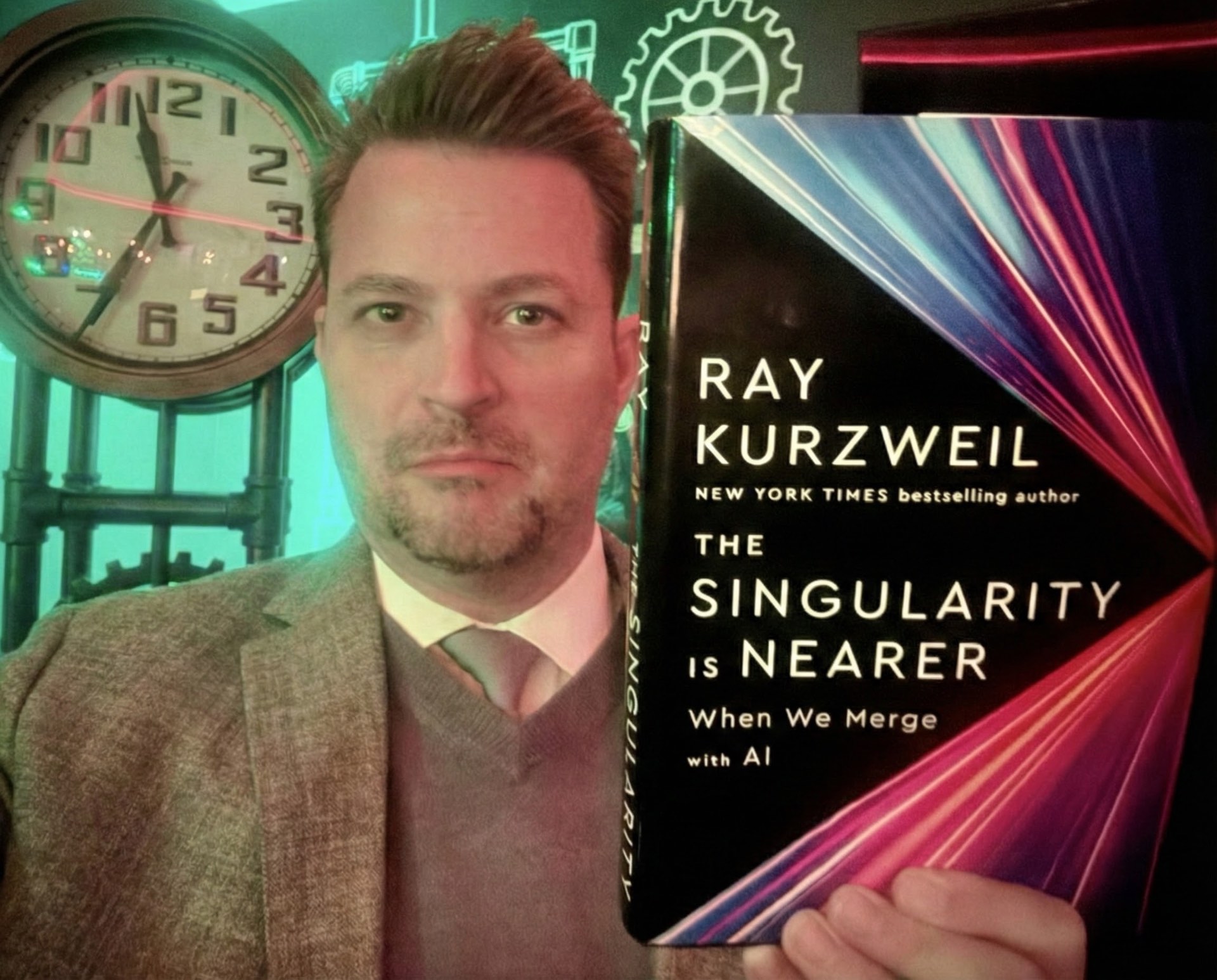
    Matt Mishak with The Singularity Is Nearer by Ray Kurzweil

    The Singularity Is Nearer

    by Ray Kurzweil

    Ray Kurzweil is not just a futurist — he's a prophet of exponential change. A student of Marvin Minsky, one of the founding minds behind the Dartmouth Conference, Kurzweil has been thinking about this moment longer than most institutions have been around.

    If you don't know Ray Kurzweil, you should. The Singularity Is Nearer makes one thing clear: the future isn't coming slowly — it's arriving all at once.

    Get the Book

    Praise from Visionaries

    "A fascinating exploration of our future, which raises the most profound philosophical questions."

    — Yuval Noah Harari

    Historian

    "Ray Kurzweil is the greatest oracle of our digital age. The Singularity Is Nearer is more than just a book—it's a survival guide for the technological renaissance we're about to experience."

    — Peter H. Diamandis, MD

    Futurist & Entrepreneur

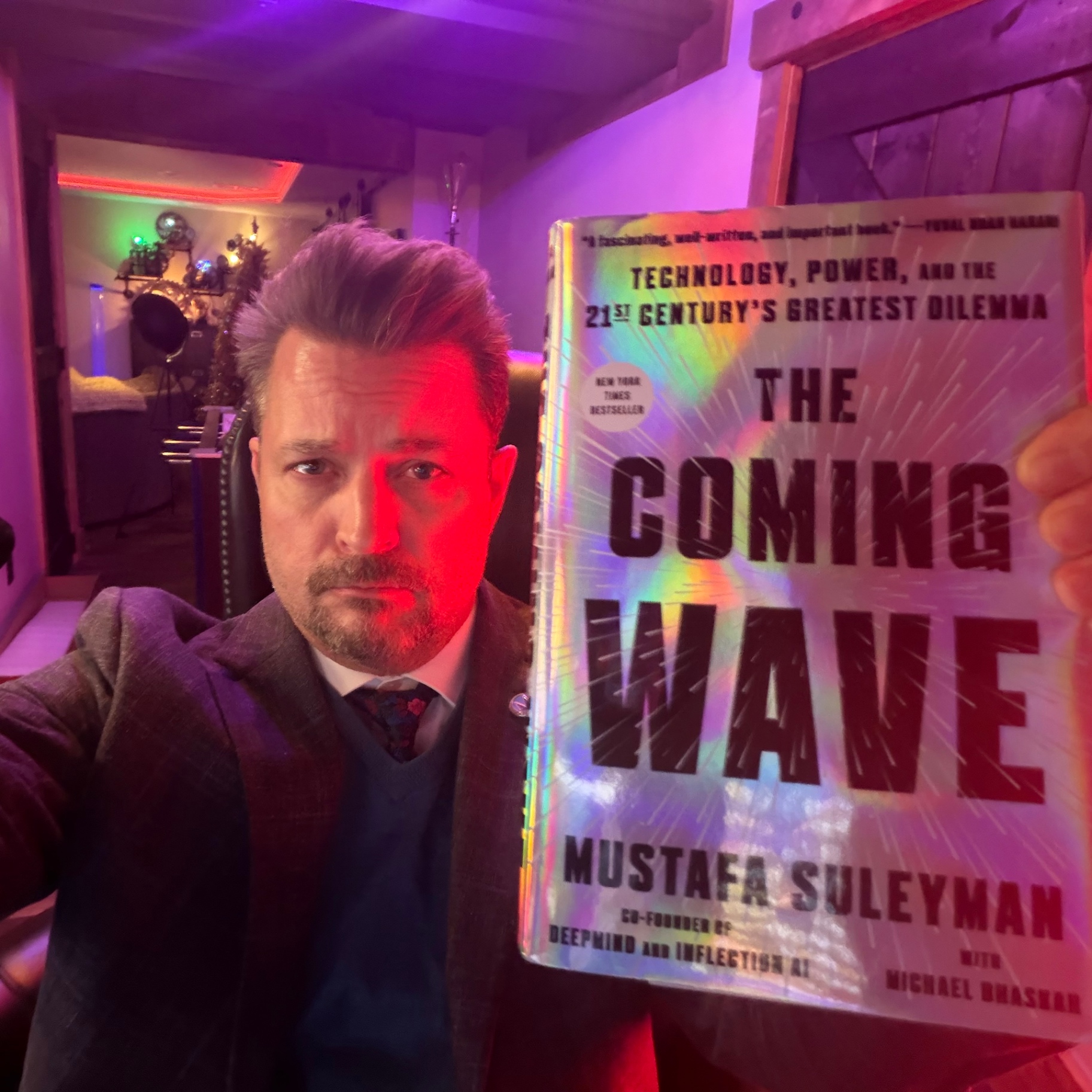
    Matt Mishak with The Coming Wave by Mustafa Suleyman

    The Coming Wave

    by Mustafa Suleyman & Michael Bhaskar

    This isn't a hype book about shiny tools. It's a sober, urgent examination of what happens when powerful technologies scale faster than our institutions, laws, and social norms. Suleyman's core message is simple but uncomfortable: the future is not something that merely happens to us. It requires participation.

    The coming wave of AI and biotechnology will not be safely "managed" by a small group of technologists or regulators alone. Containment, governance, and alignment demand broad engagement across professions, industries, and communities. Sitting on the sidelines is not a neutral position. Non-participation is still a choice, and usually a costly one.

    What makes this book especially relevant for LegalTek.ai is its insistence that responsibility must scale with capability. Lawyers, operators, founders, and leaders cannot outsource judgment to systems or defer hard questions to later. The work is now: designing guardrails, rethinking institutions, and choosing to engage rather than react. Participation is the point.

    Get the Book

    Praise from Visionaries

    "A fascinating, well-written, and important book."

    — Yuval Noah Harari

    Historian

    "One of the most important books of the year. Suleyman is one of the few people who truly understands both the promise and peril of AI."

    — Eric Schmidt

    Former CEO of Google

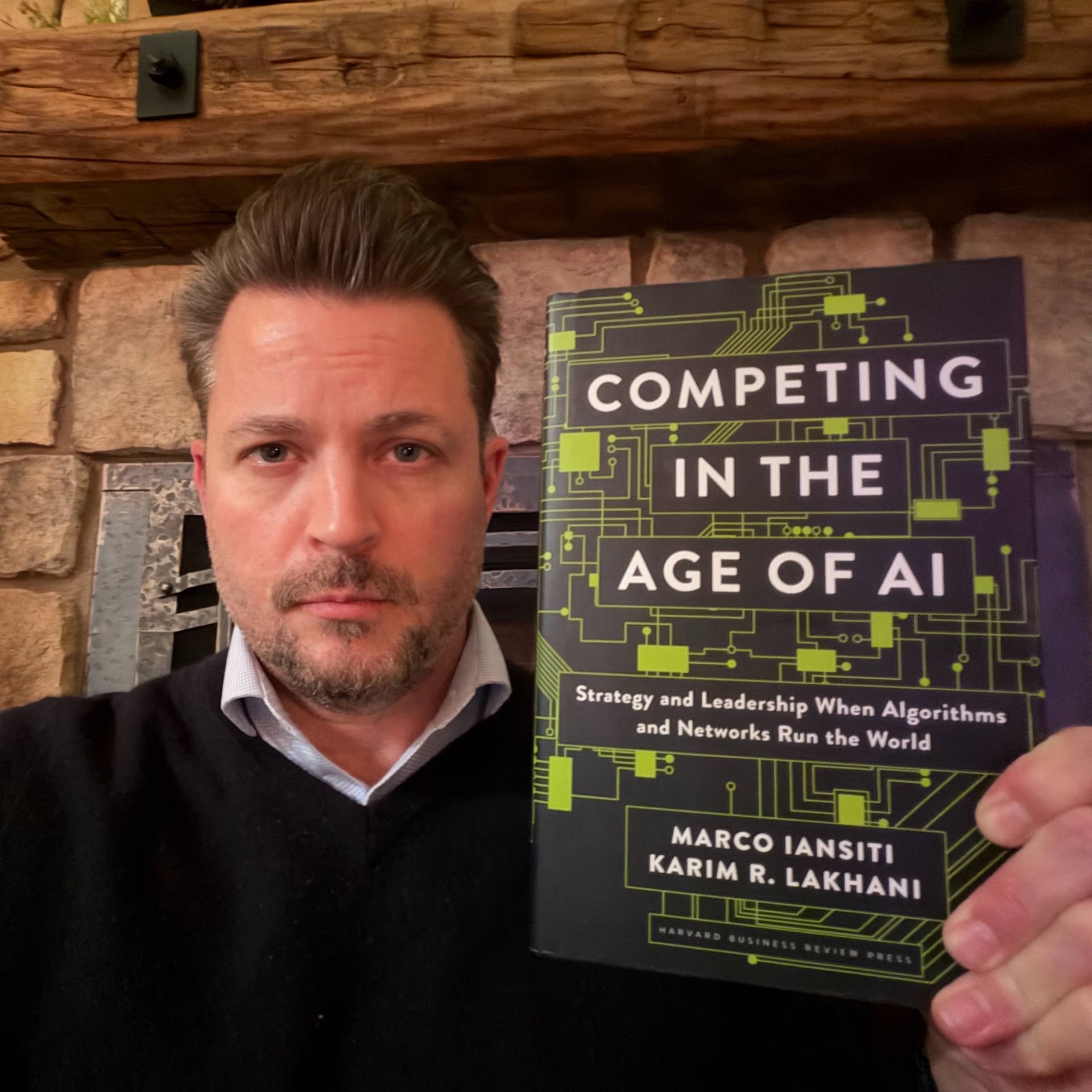
    Matt Mishak with Competing in the Age of AI by Marco Iansiti and Karim R. Lakhani

    Competing in the Age of AI

    by Marco Iansiti & Karim R. Lakhani

    Marco Iansiti and Karim R. Lakhani's Competing in the Age of AI is not a book about tools. It is a book about power, structure, and survival in an economy where software, data, and algorithms increasingly define competitive advantage. The central thesis is simple but unsettling: companies do not become AI-powered by sprinkling models on top of legacy processes. They must reorganize themselves around AI as a core operating logic.

    An AI-First organization treats data as infrastructure, not exhaust. Data lakes are not passive storage systems; they are living strategic assets continuously fed by operations, customers, and markets. The firms that win are those that design feedback loops where data improves models, models improve decisions, and decisions generate more data. This flywheel compounds faster than any traditional efficiency play.

    The book is particularly sharp on disruption. AI does not merely automate tasks; it collapses coordination costs. Entire layers of management, intermediaries, and professional gatekeepers become vulnerable when prediction and decision-making move closer to real time. This is why AI-driven firms tend to scale faster, operate with fewer humans per dollar of revenue, and exert outsized pressure on incumbents.

    Equally important is the authors' treatment of ethics and governance. AI systems embed values, whether intentionally or not. Bias, accountability, transparency, and trust are not compliance checkboxes; they are strategic concerns. Organizations that fail to govern AI responsibly risk regulatory backlash, reputational damage, and internal breakdowns of trust.

    Why this matters for LegalTek.ai: law, regulation, and professional services are precisely the kinds of industries ripe for AI-driven reconfiguration. Firms that treat AI as a bolt-on tool will fall behind. Firms that rethink workflows, data ownership, trust, and human judgment alongside AI will define the next era. If you are building, advising, regulating, or investing in the future of legal and professional services, this book belongs on your desk.

    Get the Book

    Praise from Visionaries

    "A compelling vision for how companies must transform to thrive in an AI-first world."

    — Satya Nadella

    CEO of Microsoft

    "Essential reading for any leader trying to understand how AI will reshape industries and competitive dynamics."

    — Reid Hoffman

    Co-founder of LinkedIn

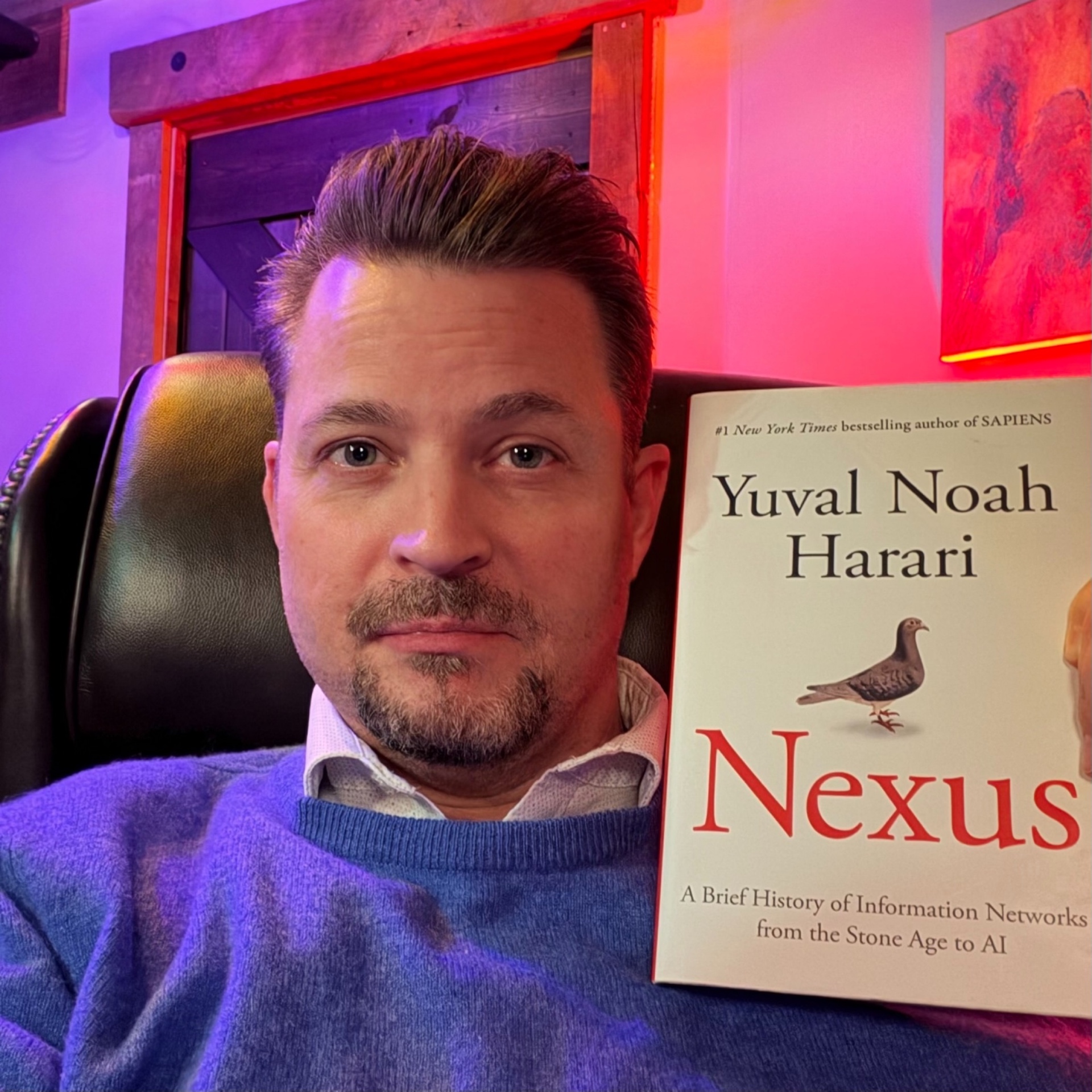
    Matt Mishak with Nexus by Yuval Noah Harari

    Nexus

    by Yuval Noah Harari

    Nexus by Yuval Noah Harari is a foundational text for anyone trying to understand how information systems shape power, institutions, and human behavior—especially as we enter an AI-driven era. Harari reframes history not as a story of tools or even ideas, but as a story of networks: who controls information flows, how trust is manufactured, and how coordination scales.

    For LegalTek.ai, this book matters because law is itself an information network. Courts, statutes, contracts, evidence, compliance regimes, and now AI models are all nodes in a living system that governs behavior at scale. Harari makes one idea uncomfortably clear: technology does not just make systems faster—it reshapes who holds authority and how legitimacy is created.

    He explores how information networks drift toward concentration, how automated decision systems can harden power asymmetries, and how societies repeatedly mistake efficiency for wisdom. These themes map directly onto modern legal technology questions around AI-assisted decision-making, automated compliance, algorithmic evidence, and the risk of opaque systems replacing human judgment.

    Key insights: First, information systems always encode values—neutral tools do not exist. This reinforces the need for explicit governance, auditability, and human oversight in legal AI. Second, scale changes ethics—what works for a small network can become dangerous when automated and deployed broadly. Third, institutions lag technology—law historically reacts after power has already shifted.

    Nexus supports a core LegalTek.ai principle: AI in law must be human-centered, transparent, and institutionally aware. The future of legal technology is not about replacing lawyers—it is about redesigning legal systems so that intelligence, whether human or artificial, serves fairness, legitimacy, and trust at scale. Highly recommended for anyone building, regulating, or relying on AI-driven legal systems.

    Get the Book

    Praise from Visionaries

    "Harari has done it again. Nexus is a sweeping, thought-provoking exploration of how information has shaped human history—and how AI might reshape our future."

    — Bill Gates

    Co-founder of Microsoft

    "A masterful synthesis of history, technology, and human nature. Essential reading for understanding where we're headed."

    — Daniel Kahneman

    Nobel Laureate in Economics

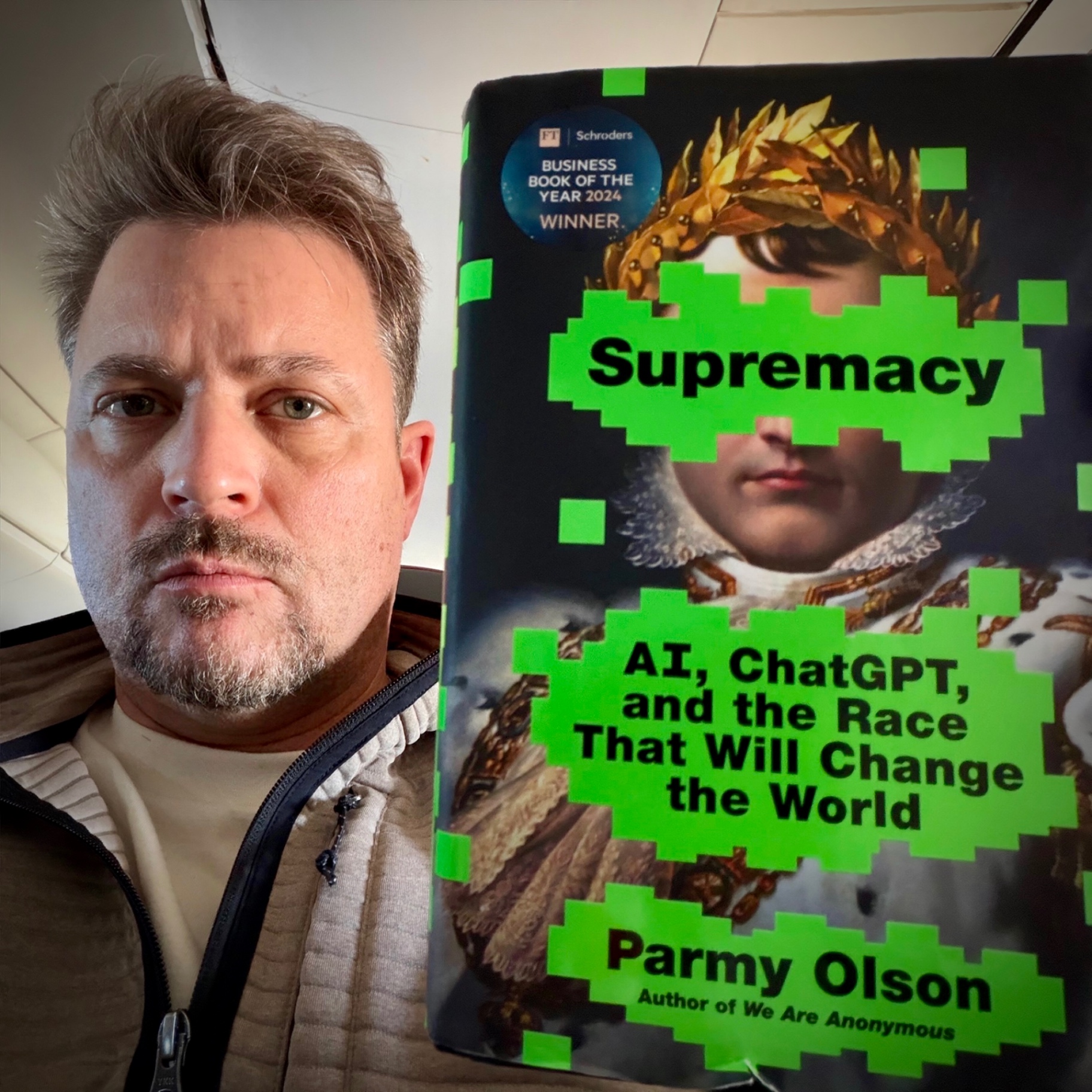
    Matt Mishak with Supremacy by Parmy Olson

    Supremacy

    by Parmy Olson

    Parmy Olson's Supremacy is the book I wish every lawyer, regulator, and founder would read before making their next move in AI. Winner of the Financial Times and Schroders Business Book of the Year 2024, this is not another breathless hype piece about what AI might do someday. It is a meticulously reported account of what has already happened — and what it means for power, competition, and control.

    Olson, a Bloomberg columnist and author of We Are Anonymous, brings a journalist's rigor and a storyteller's instinct to the AI arms race between OpenAI and Google DeepMind. She traces how a small number of researchers, executives, and investors are making decisions that will reshape every industry on earth — including law. The central tension is not technical; it is human: ambition versus caution, open research versus commercial secrecy, safety versus speed.

    What makes this book essential for LegalTek.ai readers is its unflinching examination of concentration risk. The foundation models that power legal AI products are controlled by a handful of companies. Olson documents how acquisitions, talent wars, and compute monopolies are narrowing the field in ways that should concern anyone building on top of these platforms. If you are a legal technology founder or an enterprise buyer evaluating AI vendors, this book provides the geopolitical and corporate context you cannot afford to ignore.

    Supremacy reinforces a core LegalTek.ai principle: understanding AI is not optional for legal professionals. The race for AI supremacy is not happening in a vacuum — it is reshaping the infrastructure of knowledge work itself. Lawyers who understand the forces Olson describes will be better positioned to advise clients, evaluate tools, and navigate the regulatory landscape that is still being written.

    Get the Book

    Praise from Visionaries

    "Astonishing... Olson has exclusive access to a network of high-level sources and she uses it to devastating effect."

    — Financial Times

    Business Book of the Year 2024

    "A deeply reported, utterly gripping account of the most consequential technology race of our time."

    — Tony Fadell

    Creator of the iPod, Author of Build

    Matt Mishak with Sapiens by Yuval Noah Harari

    Sapiens: A Brief History of Humankind

    by Yuval Noah Harari

    Sapiens is the book that rewired how I think about everything — law, technology, institutions, and human cooperation itself. Yuval Noah Harari doesn't just survey 70,000 years of human history; he dismantles the stories we tell ourselves about why civilization works. His central insight is deceptively simple: humans dominate the planet not because we are the smartest or strongest, but because we are the only species that can cooperate flexibly in large numbers — and we do it through shared fictions.

    For anyone in law or legal technology, this idea should hit like a thunderbolt. Laws, contracts, corporations, courts, constitutions — these are all shared fictions. They work because enough people believe in them. Harari forces you to see the scaffolding behind the systems we take for granted, and once you see it, you cannot unsee it.

    As AI begins to reshape how we create, interpret, and enforce these shared fictions, Sapiens becomes even more essential. If you want to understand where legal systems came from — and why they are so vulnerable to disruption — start here. This is the foundation that makes Nexus, The Coming Wave, and every other book on this list hit harder.

    Get the Book

    Praise from Visionaries

    "Interesting and provocative... It gives you a sense of how briefly we've been on this earth."

    — Barack Obama

    44th President of the United States

    "I would recommend this book to anyone interested in a fun, engaging look at early human history... You'll have a hard time putting it down."

    — Bill Gates

    Co-founder of Microsoft

    Matt Mishak with How to Think About AI by Richard Susskind

    How to Think About AI: A Guide for the Perplexed

    by Richard Susskind

    Richard Susskind has spent four decades thinking about the future of professional work, and How to Think About AI is the distilled vocabulary every lawyer needs for the decade ahead. This is not a tactical book about prompts or tools — it is a structured way of thinking about what AI is, what it is becoming, and what it implies for the institutions that depend on human judgment.

    The chapter that most repays a careful read is Susskind's framing of the four long-run scenarios for the human–AI relationship: AI takeover, merger, peaceful coexistence, and shut-off. He treats each seriously, not as prediction but as the realistic shape of the possibility space. His argument is that any serious conversation about AI policy or professional practice has to hold all four open at once — and most public debate collapses prematurely into one.

    For Ohio attorneys orienting around the COUNSEL Framework, this book pairs naturally with ABA Formal Opinion 512 and the Ohio Supreme Court's AI Task Force Report. The opinions tell you what your duties are. Susskind helps you decide what you believe about where the technology is headed — and that belief shapes every governance and oversight choice that follows.

    Get the Book

    Praise from Visionaries

    "Susskind is the world's leading authority on the future of legal services and one of the most lucid writers on AI for non-specialists."

    — The Times (London)

    Review

    "An indispensable guide for anyone who wants to think clearly about what AI means for their work, their profession, and their life."

    — Daniel Susskind

    Author of A World Without Work

    Matt Mishak with The Book of Elon by Eric Jorgenson

    The Book of Elon: Elon Musk's Most Useful Ideas, in His Own Words

    by Eric Jorgenson (Foreword by Naval Ravikant)

    Eric Jorgenson — the same curator who gave us The Almanack of Naval Ravikant — turns his method on Elon Musk. The Book of Elon is not a biography and not a hagiography. It is a disciplined distillation of Musk's own words on first-principles thinking, engineering, risk, capital, talent, and the long time-horizons required to build things that actually matter. Naval's foreword frames the through-line: patience compounds, and so does judgment.

    For lawyers, founders, and operators in the AI era, the value here is not Musk-worship — it is method. First-principles reasoning is exactly the discipline the profession is going to need as AI collapses coordination costs and forces us to rebuild workflows, evidence standards, and governance from the ground up. This book belongs on the shelf next to Susskind and Bennett as a working manual for how to think when the ground is moving.

    Get the Book

    Praise from Visionaries

    "Elon is the rare founder who operates from first principles at every layer of the stack — physics, engineering, capital, and time. This collection is the closest thing to a manual for how he thinks."

    — Naval Ravikant

    Founder, AngelList (from the Foreword)

    AI Strategy and Governance for Modern Law Firms

    Founded by Matthew A. Mishak, Esq. — Harvard Business School Executive Education Graduate, MIT Sloan Artificial Intelligence Graduate.

    Mission

    LegalTek.ai proves you don't have to choose between speed and care, scale and quality, efficiency and ethics. Dedicated to closing the justice gap through ethical AI adoption.

    The COUNSEL Framework for Ethical AI in Law

    Mapped to and operationalizing ABA Formal Opinion 512 (the ABA does not endorse vendor frameworks). COUNSEL stands for: Confidentiality, Oversight, Understanding, Notification, Scrutiny, Equity, and Lifetime Learning.

    SilverTung AI Concierge

    A managed AI service for legal professionals with human oversight, ethical guardrails, and COUNSEL Framework compliance.

    Core Values

    Contact

    Website: https://legaltek.ai | Twitter: @legaltek_ai