The numbers have crossed a threshold most lawyers have not noticed
In June 2023, Judge P. Kevin Castel sanctioned two New York attorneys and their small firm $5,000 for filing a brief with six fabricated citations generated by ChatGPT. The case was Mata v. Avianca. Everyone in the profession heard about it. Most of us assumed it was an aberration.
It was not. It was the opening shot.
As of early April 2026, Damien Charlotin's HEC Paris database tracks approximately 1,317 AI hallucination cases globally. Roughly 800 of them are U.S. matters. The pace has gone from a handful of cases in 2023, to about two per week in 2024, to two or three per day by spring 2025, to a reported 17 U.S. court decisions in a single day on March 31, 2026. Bloomberg Law tracked 52 improper-AI-use rulings in February 2026 alone.
The peak single sanction has gone from $5,000 in Mata to roughly $110,000 in Couvrette v. Wisnovsky (D. Or., April 4, 2026). That is a 20-fold escalation in under three years. Q1 2026 alone produced approximately $145,000 in aggregate sanctions nationwide.
And in April 2026, something happened that the profession has not fully processed yet. Judge Anna Manasco in the Northern District of Alabama, for the first time in U.S. history, imposed a direct Rule 11 sanction on a law firm itself — not just the individual attorney. The firm. The case was Rivera v. Triad Properties. The firm was Burrill Watkins LLC. The total exposure was $47,056.90 plus disqualification plus mandatory notification of every client the firm has.
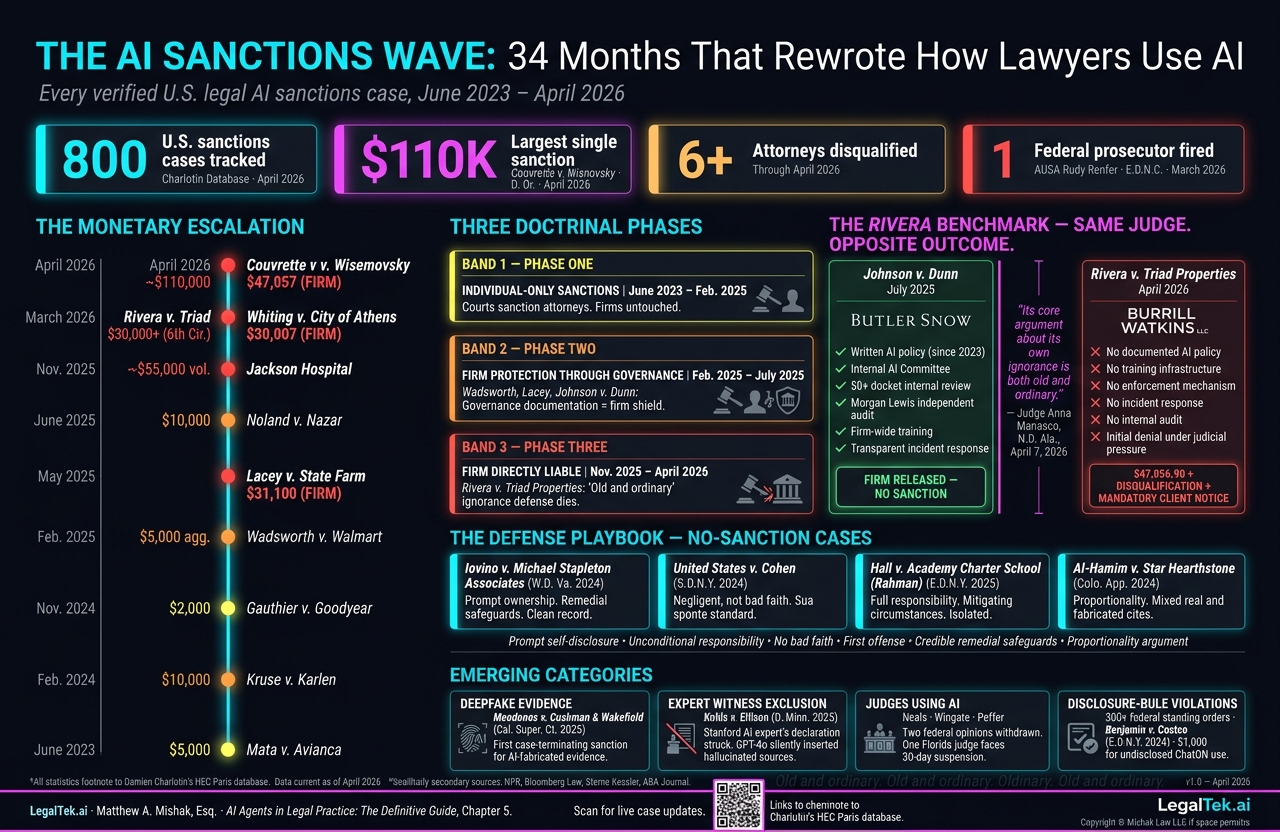
Tap to open full-size · v1.0 — April 2026 · Sourced from Damien Charlotin's HEC Paris database
The Sanctions Escalation Curve
Bars: per-case sanction. Line: cumulative U.S. AI-sanction dollars (Jun 2023 – Apr 2026).
- Per-case sanction (USD)
- Cumulative U.S. sanctions
Phase Breakdown — Where the Dollars and the Cases Cluster
Left: aggregate sanction dollars by doctrinal phase. Right: number of benchmark cases per phase.
- Phase 1
- Phase 2
- Phase 3
Phase 3 contains fewer cases but a disproportionate share of dollars — the firm-liable era is concentrated and severe.
Three doctrinal phases in 34 months
The U.S. AI-sanctions case law has moved through three distinct phases. Understanding which phase we are in matters for how firms should be thinking about liability.
Phase One — Individual-only sanctions (June 2023 – February 2025)
Mata v. Avianca set the template. Courts sanctioned individual attorneys, sometimes their small firms collectively, but did not extend liability to institutional practice structures. Park v. Kim at the Second Circuit, Kruse v. Karlen at the Missouri Court of Appeals, Gauthier v. Goodyear in the Eastern District of Texas, and the first Michael Cohen ruling all stayed in this lane. Individual attorney, individual sanction.
Phase Two — Firm protection through governance (February 2025 – July 2025)
Wadsworth v. Walmart (D. Wyo., Feb. 24, 2025) was the pivot. Judge Kelly Rankin sanctioned three Morgan & Morgan attorneys but expressly declined to sanction the firm because Morgan & Morgan had circulated firm-wide AI-risk emails, implemented training, and required post-incident verification acknowledgments. Three months later, Lacey v. State Farm produced the first monetary firm sanction — $31,100 jointly and severally against Ellis George and K&L Gates. Neither firm could demonstrate AI governance at the level Morgan & Morgan had shown. In July 2025, Johnson v. Dunn formalized the framework: Butler Snow's 2023-vintage AI cautions, its AI Committee, its 50-docket internal review, and its engagement of Morgan Lewis for an independent audit earned the firm release, while three individual Butler Snow attorneys were disqualified.
The emerging rule: firms that can prove governance escape liability; firms that cannot do not.
Phase Three — The watershed (November 2025 – April 2026)
In re Jackson Hospital (Bankr. M.D. Ala., November 2025) signaled the turn. Gordon Rees Scully Mansukhani paid approximately $55,000 in voluntary reimbursement before the court ruled and avoided formal firm sanctions. Then came Rivera v. Triad Properties on April 7, 2026. Same judge as Johnson v. Dunn, Judge Manasco. Nine months apart. Opposite outcome. The firm, Burrill Watkins LLC, could not demonstrate governance. The court sanctioned the firm directly under Rule 11, called the firm's claim of ignorance "old and ordinary," and made every client learn what had happened.
That is the arc. Individual-only, to firm-protected-by-policy, to firm-directly-liable. In 34 months.
Six attorneys disqualified. One federal prosecutor fired.
The monetary numbers are not the most consequential part of the doctrine. The career consequences are.
At least six attorneys have been disqualified from active cases as an AI-hallucination sanction:
- Rudwin Ayala in Wadsworth v. Walmart — pro hac vice revoked (Feb 2025).
- Maren Bam in Mavy v. Commissioner of SSA — pro hac vice revoked, removed as counsel of record, letters sent to the three Arizona federal judges she had falsely attributed citations to (Aug 2025).
- Matthew Reeves, William Cranford, and William Lunsford at Butler Snow — disqualified from Johnson v. Dunn with multijurisdictional bar referrals (July 2025).
- Joshua Watkins in Rivera v. Triad Properties — disqualified along with his firm (April 2026).
The first federal-prosecutor firing
AUSA Rudy Renfer, a 30-year attorney with 17 years at the Eastern District of North Carolina U.S. Attorney's Office, filed a TRICARE-coverage brief that contained fabricated quotations attributed to Fourth Circuit decisions and the CFR. The pro se plaintiff — a retired USAF colonel who happened to be a lawyer himself — noticed. Magistrate Judge Robert Numbers II issued a show-cause order. At the March 10, 2026 hearing, Renfer admitted that after "accidentally overwriting" an earlier draft, he had AI rewrite the brief and filed it "panicked." Judge Numbers was direct: "It sounds like you intentionally used AI, and intentionally filed it to the court." Renfer announced his resignation at the hearing. DOJ involuntarily terminated him the following day, March 11, 2026, before the resignation processed. The matter was referred to the Office of Professional Responsibility. It is the first known federal-prosecutor firing tied to AI hallucinations.
The cases where the court declined to sanction
Before any attorney assumes that sanctions are automatic when AI hallucinations appear in a filing, the no-sanction cases have to be read carefully. They are the defense playbook.
In Iovino v. Michael Stapleton Associates (W.D. Va., July 2024), attorney Thad Guyer of the Government Accountability Project filed a brief with two nonexistent cases and two fabricated quotations generated by a GPT-based cite-checker. Judge Cullen discharged the show-cause order, crediting Guyer's prompt unconditional responsibility, his remedial commitment to Westlaw verification plus junior-attorney cite-checking, and his unblemished record. "Mr. Guyer, to his credit, owned the mistake." The Virginia State Bar subsequently issued a private reprimand — so avoiding court sanction does not mean avoiding bar discipline. That distinction matters.
In United States v. Cohen (S.D.N.Y., March 2024), Judge Furman declined to sanction David Schwartz despite three nonexistent case citations generated by Google Bard, finding Schwartz's conduct "certainly negligent, perhaps even grossly negligent" but not in bad faith. In Hall v. Academy Charter School (E.D.N.Y., August 2025), Magistrate Judge Wicks declined to sanction Suryia Rahman after her law clerk's Google research produced three fake citations — citing recent bereavement, documented mental-health treatment, and full acceptance of responsibility. And in Al-Hamim v. Star Hearthstone, LLC (Colo. App., December 2024), the Colorado Court of Appeals expressly distinguished Kruse: the pro se appellant acknowledged AI use, apologized, and his brief mixed real and fabricated citations rather than being overwhelmingly fabricated.
The defense playbook elements
- Prompt self-disclosure before the court has to flag it
- Unconditional acceptance of responsibility without blame-shifting
- Absence of bad faith — easier to prove when disclosure is prompt
- First-offense posture and a clean disciplinary record
- Credible, specific, and documented remedial safeguards
- Proportionality argument when fabrications are mixed with real authority
Every firm facing a show-cause order for AI hallucinations should run down this list.
Rivera v. Triad Properties and why firm-level doctrine is now decisive
Every firm that is paying for an AI tool, or encouraging its attorneys to use one, needs to read Judge Manasco's April 7, 2026 opinion. Not a summary. The opinion.
Joshua Watkins of Burrill Watkins LLC filed briefs with AI-hallucinated citations. He characterized the errors as "inadvertent technical error." He blamed court staff and opposing counsel. He filed "corrected" submissions that continued to mislead. He had been separately admonished contemporaneously in a state-court matter. Judge Manasco concluded his conduct was "tantamount to bad faith." That part of the ruling is not novel.
What is novel is what she did next. She turned to the firm:
Mr. Watkins's misconduct did not occur in a vacuum. The court also has serious concerns about Burrill Watkins's apparent lack of internal controls and guardrails surrounding its attorneys' use of artificial intelligence, indeed, the very AI the firm pays for and encourages its attorneys to use. Though Burrill Watkins maintains that it acted swiftly to remediate Mr. Watkins's errors, which it says it had no reason to know about, the firm has not explained how it enforced any policies about responsible AI use, how it will prevent improper AI use going forward, or any other circumstance, let alone an extraordinary one, why it shouldn't be sanctioned.
And then she closed the firm's ignorance defense permanently:
Indeed, although Burrill Watkins's purported lack of knowledge has to do with a partner's misuse of a relatively new technology, its core argument about its own ignorance is both old and ordinary.
Old and ordinary. Those three words are the ballgame.
Firm sanctions imposed in Rivera
- $11,453 owed by the firm alone to the Triad Defendants
- $35,603.90 jointly and severally with Watkins to the Fite Defendants
- Firm disqualification from further participation
- Public reprimand of firm and attorney
- Mandatory distribution of the opinion to all clients, opposing counsel, and presiding judges in every pending case
- Internal distribution to every firm attorney
- Alabama State Bar referral
- Publication for Federal Supplement inclusion
Same judge. Johnson v. Dunn in July 2025 released Butler Snow without sanction because Butler Snow had a 2023-vintage AI policy, an AI Committee, a 50-docket internal review, and an independent Morgan Lewis audit. Rivera in April 2026 sanctioned Burrill Watkins directly because Burrill Watkins could not document any of those things. Same supervisory-duty analysis under Rules 5.1 and 5.3. Opposite outcome. The distinguishing fact is whether the firm had governance it could point to.
This is now the rule. Firms that can prove governance get protection. Firms that cannot face direct monetary exposure. The "we didn't know" defense is dead.
What a firm actually needs to have in place
Firms that were protected
- ✓ Written AI policy predating the incident
- ✓ Firm-wide training with acknowledgments
- ✓ Documented enforcement mechanisms
- ✓ Incident-response protocols
- ✓ Supervisory accountability under Rules 5.1 / 5.3
- ✓ Independent audit (Morgan Lewis-style)
Firms that were sanctioned
- ✗ No written policy, or paper-only with no training
- ✗ No incident response when first problem emerged
- ✗ Initial denial of AI use; admission only under pressure
- ✗ No internal review after the fact
- ✗ No forward-looking supervision mechanisms
- ✗ "We didn't know" as primary defense
Butler Snow's governance infrastructure cost the firm nothing in Johnson v. Dunn despite three of its attorneys being disqualified. Burrill Watkins's absence of governance cost the firm $47,056.90, its continued participation in the case, and the obligation to tell every client the firm has what happened.
For a small or mid-sized firm, that math is not close. Building a documented AI governance program is cheaper than a single $47,000 sanction.
Beyond fabricated citations: the categories emerging now
Fabricated citations are the category everyone reads about. They are not the only category. Four others are generating their own jurisprudence.
Deepfake evidence
In Mendones v. Cushman & Wakefield (Cal. Super. Ct. Alameda, Sept 2025), pro se plaintiffs submitted AI-generated witness testimonials and fabricated Ring-camera footage. Telltale artifacts: looping clips, monotone AI voices, mismatched lip-sync, and metadata claiming iOS 12.5.5 on an iPhone 6 while Apple Intelligence features required an iPhone 15 Pro. Judge Kolakowski imposed terminating sanctions — dismissal with prejudice — under Cal. Code Civ. Proc. § 128.7(b). First case-terminating sanction in the U.S. for AI-fabricated evidence.
Expert witnesses excluded
Kohls v. Ellison (D. Minn., Jan 2025) is the Daubert precedent. Stanford Professor Jeff Hancock — director of the Stanford Social Media Lab and a credentialed expert on AI misinformation — used GPT-4o to draft paragraphs with "[cite]" placeholders. GPT-4o silently replaced them with two nonexistent academic articles and one misattribution. Judge Provinzino struck the declaration entirely: "The irony. Professor Hancock, a credentialed expert on the dangers of AI and misinformation, has fallen victim to the siren call of relying too heavily on AI, in a case that revolves around the dangers of AI, no less."
Judges using AI
Judge Julien X. Neals (D.N.J.) withdrew his June 30, 2025 opinion in In re CorMedix Securities Litigation after defense counsel flagged fabricated quotes — a law-school intern had used ChatGPT without authorization. Judge Henry T. Wingate (S.D. Miss.) withdrew a July 20, 2025 TRO containing nonexistent parties and misquoted statutes; a clerk had used Perplexity as a "foundational drafting assistant." Judge Lauren Peffer of Broward County, Florida faces a JQC recommendation of a 30-day suspension, public reprimand, $10,000 fine, and costs for her 2024 campaign use of an AI-fabricated 18-minute audio of sitting Florida Supreme Court justices.
AI disclosure rule violations
Judge Brantley Starr's May 2023 standing order has been joined by over 300 federal judicial standing orders and local rules addressing generative AI. Benjamin v. Costco (E.D.N.Y. 2024) imposed a $1,000 penalty for undisclosed ChatON use. Proposed FRE 707 (machine-generated evidence) was approved by the Judicial Conference in June 2025 and is in public comment through February 2026. Proposed FRE 901(c) addresses potentially fabricated AI evidence. Both are expected to be published as final rules within 18 months.
What this means for the small and mid-sized firm
- The assumption that AI sanctions are a big-firm problem is wrong. Pro se appellants have been sanctioned ($10,000 in Kruse, case-dismissed in Mendones). Solo and small-firm practitioners have been sanctioned (Colorado's People v. Crabill — one-year-and-a-day suspension). The Am Law 100 firms that have been sanctioned almost without exception had better governance to fall back on than most small firms have. The risk profile for the small and mid-sized firm is higher, not lower.
- The defense playbook is available — but only if the firm has the documentation to use it. Prompt self-disclosure requires someone at the firm to have flagged the problem before the court did. Credible remedial safeguards require those safeguards to exist. Every element of the Iovino / Cohen / Hall / Al-Hamim playbook assumes preexisting governance most firms do not have.
- The cost asymmetry is now lopsided. Building a documented governance program — written policy, firm-wide training, enforcement mechanisms, incident response, supervisory Rule 5.1/5.3 accountability, and ongoing audit — costs a fraction of a single Rivera-sized sanction. And after Rivera, the sanctions include mandatory client notification. Try explaining to your best client why they are receiving a copy of a federal court opinion naming your firm for AI misconduct. Try explaining the same thing to your malpractice carrier at renewal.
The 800 cases are not a warning anymore. They are the rule. The next phase of the case law, likely emerging in the second half of 2026, will be about firms that saw Rivera and did not build governance in time.
The interactive case database & the governance playbook
This article is the narrative arc. For the case-by-case database — every verified U.S. sanction with the rule violated, the conduct, and the COUNSEL Framework dimension that would have prevented it — see the companion resource. For the operational governance playbook the protected firms used, see the COUNSEL Framework.
The bottom line
Eight hundred U.S. cases. One hundred and ten thousand dollars in the largest single sanction. Six disqualifications. One federal prosecutor fired. And now, as of April 7, 2026, the first direct Rule 11 sanction against a law firm itself, with every client learning what happened.
If the firm is using AI without a written policy, it is not a question of whether a court sees the gap. It is a question of when.
Matthew A. Mishak
Managing Attorney, Mishak Law LLC (Amherst, OH); Law Director, Village of South Amherst, OH; Founder & CEO, LegalTek.ai LLC. Former prosecutor, forensic accountant, and early commercial drone-law pioneer.
Not legal advice. This article is for informational and educational purposes only and does not constitute legal advice. It does not establish an attorney–client relationship. Consult qualified counsel licensed in your jurisdiction before acting on any matter discussed here. LegalTek.ai is a technology company, not a law firm.
Underlying case counts reference the Damien Charlotin AI hallucination database at HEC Paris, Bloomberg Law February 2026 reporting, and the published opinions cited throughout. This article accompanies Chapter 5 of AI Agents in Legal Practice: The Definitive Guide.