A Tale of Two Cases
The Rivera Benchmark
What Butler Snow got right, what Burrill Watkins got wrong, and why your firm’s AI governance is now evidence.

Not legal advice. This post is provided for educational purposes only and does not constitute legal advice. Firms should independently verify all rule citations against their applicable jurisdiction before adopting any policy described here. Citations flagged for single-source verification should be independently confirmed before any reliance. Case facts reflect the public record as of the cited dates.
In this report
- 01Two paths, one firm
- 02The amnesty conversation
- 03The Rivera Benchmark
- 04Side-by-side comparison
- 05Johnson v. Dunn — survival template
- 06Rivera v. Triad — sanction template
- 07What “old and ordinary” means
- 08The COUNSEL framework, applied
- 09Ohio practitioners
- 10Amnesty-for-disclosure posture
- 11Conclusion: policy as evidence
- 12Appendix: sources
Two paths, one firm
Every law firm in 2026 is on one of two paths. The first is governed: a written AI policy, an internal committee, supervisory architecture under Model Rules 5.1 and 5.3, verification protocols, and continuing education. The second is ungoverned: shadow tool use, no audit trail, and the quiet certainty that the next hallucinated citation in a filing will be the firm's first sanctions hearing.
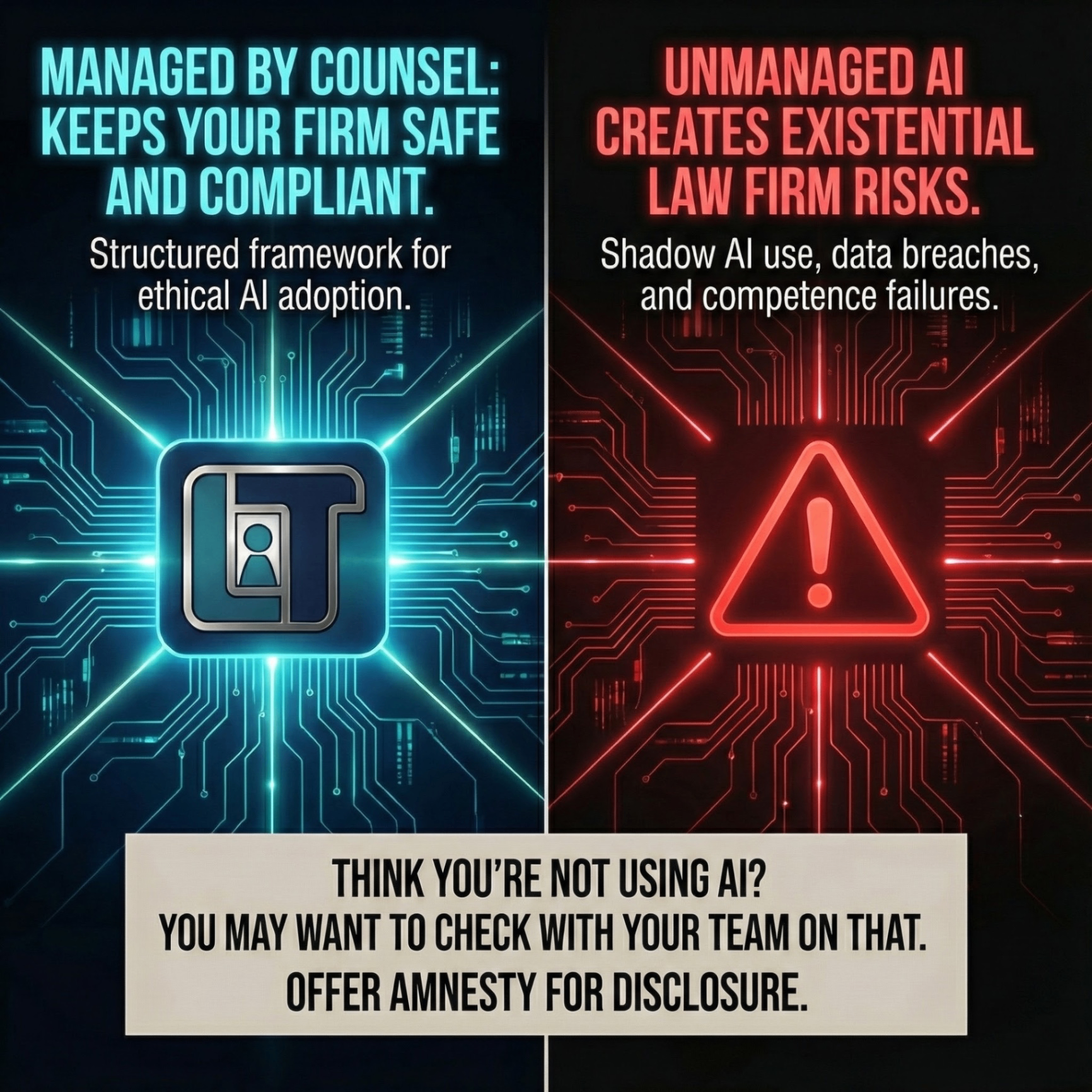
The visual at the top of this post is the choice in two panels. On the left, structured AI adoption protected by the COUNSEL framework. On the right, an unmanaged perimeter — circuits radiating outward, no one watching where the data flows. The cases now coming out of federal courts are making it brutally clear which side you want to be on.
Managed by COUNSEL
- Written AI PolicyDocumented inputs, approved tools, and authorization gates before any client-facing use.
- Supervisory ArchitectureAn AI committee, practice group leader sign-off, and Rule 5.1/5.3 oversight that holds up in evidence.
- Verification ProtocolEvery citation, quote, and authority independently confirmed before filing — Mata-proof.
- Client Notice & Fee DisciplineRule 1.4 communication and ABA Op. 512 fee rules baked into intake and billing.
- Continuous TrainingFirmwide CLE-style education that satisfies Model Rule 1.1 cmt. [8] competence duties.
Unmanaged AI
- Shadow AI UseAssociates and partners pasting client data into consumer chatbots with no audit trail.
- Confidentiality BreachesPrivileged material flowing into systems that may train on inputs — straight Rule 1.6 exposure.
- Hallucinated CitationsFabricated quotes and non-existent precedent landing in filings. Mata, Johnson, and Rivera all started here.
- Competence FailuresNo verification protocol means every brief is a Rule 1.1 and Rule 3.3 risk before it leaves the office.
- Unbillable RemediationOp. 512 prohibits charging clients to clean up AI mistakes. Firms eat the cost — and the sanctions.
“We don’t use AI” is the most dangerous sentence in your firm
The single most dangerous belief a managing partner can hold in 2026 is "we don't use AI." The 2025 Thomson Reuters and ABA TechReport surveys both put generative-AI usage among practicing lawyers north of fifty percent. The actual rate inside your firm — measured honestly — is almost certainly higher than what is officially sanctioned.
Associates draft research memos in ChatGPT on personal accounts. Paralegals summarize discovery in Claude. Marketing pastes engagement-letter language into Copilot. Every one of those touches is a potential Rule 1.6 confidentiality breach, a Rule 5.3 supervisory failure, and — when it lands in a filing — a Mata-style citation problem in the making.
You cannot govern what you cannot see. The first step is not policy. The first step is amnesty.
The Amnesty Conversation
A script you can use Monday morning.
- 01We are conducting an internal review of all AI tool use at the firm.
- 02If you have used ChatGPT, Claude, Gemini, Copilot, or any generative AI tool for firm work — even once — we need to know.
- 03There will be no discipline for honest disclosure made before [date].
- 04After that date, undisclosed use found through audit will be treated as a separate violation.
- 05This protects you, your clients, and the firm. It is the only way we can map our exposure and put real guardrails in place.
The amnesty window typically runs ten business days. After it closes, the firm has an honest map of its actual AI footprint — the prerequisite to every COUNSEL control that follows.
The Rivera Benchmark
Same judge. Same courtroom. Opposite outcome.
In the span of nine months, the Honorable Anna M. Manasco of the United States District Court for the Northern District of Alabama issued two sanction orders that, read together, establish the first clean natural experiment in firm-level AI governance. The facts were comparable. The conduct was comparable. The hallucinated citations were comparable. Yet one firm walked away without a mark on its institutional record, while the other absorbed a $47,056.90 fee award, disqualification, a public reprimand, and an order requiring mandatory notice to every client and every presiding judge in every pending matter.
The difference was not luck. It was architecture.
Johnson v. Dunn, 792 F. Supp. 3d 1241 (N.D. Ala. 2025), and Rivera v. Triad Properties Corp., Doc. 116 (N.D. Ala. 2026), are now the bookends of what I call the Rivera Benchmark. Together they answer a question every managing partner, general counsel, and solo practitioner in Ohio should be prepared to answer on twenty-four hours’ notice: when your lawyer fails with AI, what did the firm build before the failure, and what can you put in evidence after it?
This is not theoretical. Damien Charlotin’s public hallucination tracker recorded roughly 1,333 identified cases globally by mid-April 2026, with approximately eight hundred in United States courts. The volume has outrun the deterrent effect of the early generation of sanctions. Judge Manasco’s pair of rulings marks the moment when courts stopped asking only what the lawyer did and started asking what the firm had in place.

A side-by-side comparison
Before the analysis, the raw data. The table below strips both cases down to their comparable elements.
Johnson v. Dunn vs. Rivera v. Triad Properties
| Element | Johnson v. Dunn (Butler Snow) | Rivera v. Triad (Burrill Watkins) |
|---|---|---|
| Court | N.D. Ala., Judge Manasco | N.D. Ala., Judge Manasco |
| Date of sanction order | July 23, 2025 | Late March / early April 2026 |
| AI tool used | ChatGPT | Not specified in public excerpts |
| Underlying matter | Eighth Amendment prisoner claim | State-law commercial dispute |
| Defective filings | 2 discovery motions, 5 fabricated citations | Multiple briefs, fabricated quotations & misattributed precedent |
| Doctrinal basis | Inherent authority under Chambers v. NASCO | Rule 11 and inherent authority |
| Written AI policy before incident | Yes — June 2023 GC memo + Jan 2025 CoCounsel addendum | None in the public record |
| Internal AI committee | Yes | None disclosed |
| Firm-wide training | Yes | None disclosed |
| Enforcement mechanism | Practice group leader approval gate | None disclosed |
| Independent post-incident audit | Morgan, Lewis & Bockius — 2,400+ citations across 330 filings | None |
| Initial response to court | Prompt disclosure; certified client would not be billed | “Inadvertent technical error”; corrective papers buried truth in “convoluted footnotes” |
| Client communication | Disclosed to Alabama Attorney General | Falsely represented clients informed; contradicted by client testimony |
| Firm sanctioned | No | Yes |
| Individual attorneys sanctioned | Three partners / of counsel disqualified, reprimanded, bar referral | Joshua B. Watkins disqualified, reprimanded, bar referral |
| Monetary sanction | None against firm; no fine against individuals | $47,056.90 — $11,453 firm → Triad; $35,603.90 jointly & severally Watkins/firm → Fite Defendants |
| Mandatory notice | Every client, opposing counsel, and presiding judge in every pending matter (individuals only) | Every client, opposing counsel, and presiding judge in every pending matter (firm + attorney) |
| Judicial characterization | “Recklessness in the extreme, and tantamount to bad faith” as to individuals; “no evidentiary basis” for firm-level bad faith | Firm’s ignorance argument dismissed as “both old and ordinary” |
Two identical underlying failures. Two opposite institutional outcomes. The table explains why.
Johnson v. Dunn — the survival template
Butler Snow partner Matthew B. Reeves used ChatGPT to draft two discovery motions defending former Alabama Department of Corrections Commissioner Jefferson Dunn in an Eighth Amendment failure-to-protect action. Plaintiff’s counsel caught five fabricated citations on May 15, 2025. Judge Manasco issued a show-cause order the next day, held a hearing on May 21, and ruled on July 23.
Because Rule 11(d) excludes discovery motions from Rule 11 jurisdiction, the court proceeded on its inherent authority under Chambers v. NASCO, Inc., 501 U.S. 32 (1991). That doctrinal choice raised the required finding from objective unreasonableness to bad faith or conduct “tantamount to bad faith.” Judge Manasco made that finding against Reeves and two supervising colleagues, William J. Cranford III and William R. Lunsford. All three were disqualified from the case, publicly reprimanded, ordered to distribute the sanction order to every client, opposing counsel, and presiding judge in every pending matter, and referred to the Alabama State Bar and all other licensing authorities. The court imposed no monetary fine, explaining that “if fines and public embarrassment were effective deterrents, there would not be so many cases to cite.” 792 F. Supp. 3d at 1266.
The firm was another matter entirely. Judge Manasco catalogued Butler Snow’s pre-existing governance architecture and concluded there was “no evidentiary basis for a finding that the firm acted in bad faith or with such recklessness that its conduct was tantamount to bad faith.” Id. at 1262. That architecture, documented in the firm’s sanctions response, included six elements worth naming:
- A general-counsel-authored AI policy, circulated firmwide in June 2023 by Benjamin M. Watson, warning that large-language-model output “can appear perfectly researched and logical while in fact it is wholly inaccurate.”
- A permission gate requiring written approval from the practice group leader before using AI as a secondary research tool.
- A January 2025 policy addendum, triggered by the rollout of Westlaw’s CoCounsel, requiring that “all outputs must be reviewed and verified by the responsible attorney.”
- An active AI committee drafting a comprehensive firmwide policy.
- A post-incident internal review of 52 Alabama federal dockets, including 40 with substantive citations, yielding no additional hallucinations.
- An independent audit by a 28-attorney Morgan, Lewis & Bockius team led by partner Scott A. Milner, reviewing more than 2,400 separate legal citations across 330 filings in 40 dockets spanning all Alabama federal courts and the Eleventh Circuit, again yielding no additional fabricated citations.
The firm also certified that the State of Alabama would not be billed for any of this remediation, and Reeves was ordered, as part of his individual sanction, to develop an AI-risk education curriculum with plaintiff’s counsel at the University of Alabama and Samford law schools.
Rivera v. Triad Properties — the sanction template
Nine months later, the same bench heard a similar story with a different institutional posture. Joshua B. Watkins of Burrill Watkins LLC filed state-law briefs containing fabricated quotations, misrepresentations of state supreme court precedent, and a citation to a volume of the Southern Reporter that housed a different case entirely. A quotation attributed to Ex parte Reindel did not appear in that decision. A cite to “293 So. 3d 930 / Skinner v. Beemer” actually corresponded to Ex parte K.W. Reliance on Jordan v. Mitchell supported an equitable rule the case had not addressed.
Watkins first framed the errors as an “inadvertent technical error.” He then filed corrective papers that the court found buried the true extent of the misconduct in “convoluted footnotes.” He represented that he had kept his clients fully informed. Named plaintiff Dulce Rivera testified under oath that she had not been informed and had previously asked the firm to remove Watkins from the matter. The court found the misrepresentations intentional and later professions of accountability “feigned.”
Burrill Watkins, sensing exposure, argued that it had no reason to know of Watkins’s AI misuse and had acted swiftly to remediate. Judge Manasco rejected the argument in the passage that now anchors the emerging doctrine of firm-level AI liability:
Mr. Watkins’s misconduct did not occur in a vacuum. The court also has serious concerns about Burrill Watkins’s apparent lack of internal controls and guardrails surrounding its attorneys’ use of artificial intelligence, indeed, the very AI the firm pays for and encourages its attorneys to use. Though Burrill Watkins maintains that it acted swiftly to remediate Mr. Watkins’s errors, which it says it had no reason to know about, the firm has not explained how it enforced any policies about responsible AI use, how it will prevent improper AI use going forward, or any other circumstance, let alone an extraordinary one, why it shouldn’t be sanctioned. Indeed, although Burrill Watkins’s purported lack of knowledge has to do with a partner’s misuse of a relatively new technology, its core argument about its own ignorance is both old and ordinary.
Six sanctions followed, modeled on Johnson v. Dunn but escalated against the firm because governance evidence was absent. Public reprimand of attorney and firm. Mandatory distribution of the order to every client, opposing counsel, and presiding judge in every pending case. Publication in the Federal Supplement. Disqualification of both Watkins and Burrill Watkins from the matter. Bar referral. And $47,056.90 in fees, allocated $11,453.00 from the firm to the Triad Defendants and $35,603.90 jointly and severally from Watkins and the firm to the Fite Defendants.
Where the Johnson court found no evidentiary basis for firm-level bad faith, the Rivera court found that the absence of documentation was itself probative of bad faith. The inversion is precise.
What “old and ordinary” actually means
Judge Manasco’s “old and ordinary” sentence is doing more work than a rhetorical flourish suggests. It translates a classical common-law principle into the generative-AI era. A principal cannot escape responsibility by disclaiming knowledge of what the principal has incentivized an agent to do. A firm that pays for AI, deploys AI, and encourages its lawyers to use AI has affirmatively created a risk and therefore bears the burden of showing it contained the risk.
That principle lives in Model Rules 5.1 and 5.3, which require supervising lawyers to “make reasonable efforts to ensure that the firm has in effect measures giving reasonable assurance” of conformity to the rules. ABA Formal Opinion 512, issued July 29, 2024, had already translated those duties into the AI context by imposing seven overlapping obligations: competence, confidentiality, communication, supervision, candor, meritorious claims, and reasonable fees. On supervision specifically, the opinion directed managerial and supervisory lawyers to establish “clear policies regarding the law firm’s permissible use of GAI,” to train lawyers and nonlawyers, and to ensure compliance extending to vendors.
Before Rivera, Formal Opinion 512 read as advisory. After Rivera, it reads as a sanction predicate.
Three moving parts deserve isolation. First, the Rivera court reads inherent authority over firms through the Opinion 512 framework. Second, it treats the absence of documented enforcement as evidence of bad faith. Third, it refuses to credit post-show-cause remediation when nothing predated the incident. In Johnson, Butler Snow’s audit was powerful because the policy came first. In Rivera, Burrill Watkins’s remediation was insufficient because nothing came first.
The COUNSEL framework, applied
The COUNSEL framework I developed at LegalTek.ai organizes firm-level AI compliance into seven dimensions drawn from the Model Rules and Formal Opinion 512. It is diagnostic, not decorative. Applied to these two cases, it explains with near surgical precision why Butler Snow survived and why Burrill Watkins did not.
Cis for Confidentiality
Model Rule 1.6; ABA Formal Opinions 512, 477R, 08-451; In re Skinner, 740 S.E.2d 171 (Ga. 2013).
2023 policy restricted AI input paths and required practice group leader authorization before client-facing use.
No written confidentiality protocol governing data inputs to third-party generative systems. Sending client information to an unvetted model is a Rule 1.6 question, not a technology question.
Ois for Oversight
Model Rules 5.1, 5.3, and 5.5; ABA Formal Opinion 08-451; Smith v. Farwell, 2024 WL 4002576 (Mass. Super. Ct. Feb. 12, 2024); Mata v. Avianca, Inc., 678 F. Supp. 3d 443 (S.D.N.Y. 2023).
Active AI committee, practice group leader approval gate, and general-counsel-authored circulation satisfied the “reasonable efforts” language of Rule 5.1(a).
No evidence of any supervisory regime. The Rivera order targeted this gap directly when it asked how the firm “enforced any policies about responsible AI use.”
Uis for Understanding
Model Rule 1.1 and Comment [8]; In re Collura, 118 N.E.3d 804 (Ill. 2018); Mata v. Avianca.
January 2025 CoCounsel addendum, training rollout, and supplemental June 2, 2025 response documented a firmwide understanding that AI output requires independent verification.
Use without verification is what Mata labeled professionally incompetent as early as 2023. Ohio Prof. Cond. R. 1.1 cmt. [8] has encoded this same competence duty since April 1, 2015.
Nis for Notification
Model Rule 1.4; ABA Formal Opinion 512 at 7-9; ABA Formal Opinion 08-451.
Disclosed to the Alabama Attorney General and certified the client would bear no cost of remediation.
Falsely represented to the court that he had informed his clients — contradicted in open court by Ms. Rivera herself. The gap between a Rule 1.4 floor and a Rule 8.4(c) violation. Judge Manasco called Watkins’s contrition “feigned.”
Sis for Scrutiny
Model Rules 1.1, 1.3, 3.3, and 8.4(c); Mata v. Avianca; Smith v. Farwell.
Morgan Lewis audit of 2,400 citations across 330 filings — the cleanest example of post-incident scrutiny in the reported case law and the template Judge Manasco credited.
No auditable review. Johnson’s “tantamount to bad faith” language signals that when citation verification is absent, Rule 3.3 candor and Rule 1.1 competence collapse into the same violation.
Eis for Equity
Model Rules 8.4(g) and 1.5; ABA Formal Opinions 93-379 and 512 at 13-15; Attorney Grievance Comm’n v. Monfried, 794 A.2d 92 (Md. 2002); In re Gerard, 548 N.E.2d 1051 (Ill. 1989).
Certification that Alabama would not be billed for remediation tracked Formal Opinion 512’s directive that lawyers may not charge clients for time spent learning general AI technology.
Use of a firm-subsidized AI tool with no documented pass-through rule left the firm exposed on fee equity even before the court’s $47,056.90 award addressed the question.
Lis for Lifetime Learning
Model Rule 1.1 cmt. [8]; Model Rule 5.1; state CLE regimes.
Firmwide training and a commitment to a CLE-style education program mapped cleanly to continuing-competence duties.
No evidence of structured training or continuing curriculum. Ohio Rule 1.1 cmt. [8] carries the competence obligation forward whether or not Ohio adopts a specific AI-CLE mandate.
What this means for Ohio practitioners
Ohio has been technology-competence ready since the Supreme Court adopted ABA Comment [8] verbatim, effective April 1, 2015. Ohio Prof. Cond. R. 1.1 cmt. [8] requires Ohio lawyers to “keep abreast of changes in the law and its practice, including the benefits and risks associated with relevant technology.” That single sentence makes AI literacy a disciplinary matter in Ohio, not a theoretical best practice.
The Ohio Board of Professional Conduct has not issued an AI-specific advisory opinion as of April 2026. The Supreme Court of Ohio hosts an Artificial Intelligence Resource Library for judges and practitioners, but the library is informational and declines to endorse specific tools. The Ohio State Bar Association has published member-facing guidance in Ohio Lawyer, and Ohio Bar Liability Insurance Company has circulated a model AI-use policy to insureds, but neither is binding authority. The practical inference is that Ohio regulators will apply existing rules to AI conduct rather than wait for an AI-specific regulation.
Ohio federal courts are not waiting. In the Southern District, Judge Michael J. Newman’s Standing Order Governing Civil and Criminal Cases, effective July 14, 2023 and revised December 14, 2023, bars any AI use to prepare any filing, with a narrow carveout for Westlaw, Lexis, and conventional search engines. In the Northern District, Judge Christopher A. Boyko’s Standing Order on the Use of Generative AI is substantively identical and invokes Rule 11 and the court’s inherent authority for enforcement. Ohio practitioners appearing before those judges face a per se rule, not a reasonableness standard.
Enforcement has arrived in Ohio. Senior Judge Walter H. Rice of the Southern District of Ohio imposed a collective sanction on two attorneys in early 2026 for hallucinated citations, found them in contempt, and referred them to the Ohio Office of Disciplinary Counsel, describing the conduct as the most egregious Rule 11 violation of his 46-year tenure. (Single source: ABA Journal; underlying docket requires verification.)
For Ohio managing partners, the Rule 5.1 supervisory duty runs in two directions. Prospectively, the firm must adopt a written AI policy, document training, and establish an enforcement mechanism before any matter is filed. Retrospectively, the firm must audit on a schedule short enough that drift is caught internally rather than by a show-cause order from a federal judge.
The amnesty-for-disclosure posture
No court, bar, or ABA committee has formally adopted an amnesty-for-disclosure safe harbor for internal AI audits. The concept nonetheless exists de facto in the case law. Wadsworth v. Walmart Inc., 348 F.R.D. 489 (D. Wyo. 2025), credited Morgan and Morgan’s pre-sanction remediation. Johnson v. Dunn credited Butler Snow’s Morgan Lewis audit. In both cases, the firm escaped institutional sanction because it had disclosed and remediated before the court had to order either.
The strategic calculus is direct. A firm that discovers shadow AI use through an internal audit controls scope, chooses its own reviewer, and can certify to the court that no client will bear remediation cost. A firm that waits for a show-cause order surrenders all three advantages. That is the difference between the posture Butler Snow brought to the Johnson hearing and the posture Burrill Watkins brought to the Rivera hearing.
Three operational recommendations
Beyond those three, consider extending an explicit amnesty window to associates, of counsel, and staff. Tell them in writing that disclosure of past AI use within a defined window will not be grounds for discipline. The alternative is learning about a ChatGPT-drafted brief the same way Judge Manasco did — from opposing counsel or from the bench.
Conclusion: your policy is now evidence
The Rivera Benchmark is not an abstraction. It is an evidentiary standard. When a firm appears before a court after an AI failure, the court will ask what existed in writing before the failure. If the firm can produce a policy, a training record, an audit protocol, and an incident response, the firm may join Butler Snow on the survivor side of the line. If the firm cannot, it will join Burrill Watkins on the sanctioned side.
The governing rules have not changed. Model Rules 1.1, 1.3, 1.4, 1.6, 3.3, 5.1, 5.3, and 8.4 still carry the weight, and their Ohio analogs apply with equal force. ABA Formal Opinion 512 still articulates the seven duties. What has changed is that a federal district judge has drawn a line between diligent and negligent firms in a sanction order, drawn it twice in nine months, and reached opposite results each time. The variable was institutional architecture.
If a show-cause order arrived tomorrow, what could your firm file in response? Whatever the answer, that is your governance.
Appendix: sources & further reading
Primary opinions and dockets
- Johnson v. Dunn, 792 F. Supp. 3d 1241 (N.D. Ala. 2025)
- Johnson v. Dunn — CourtListener docket
- Rivera v. Triad Properties Corp. — Volokh Conspiracy excerpt (Apr. 7, 2026)
- Mata v. Avianca, Inc., 678 F. Supp. 3d 443 (S.D.N.Y. 2023)
- Park v. Kim, 91 F.4th 610 (2d Cir. 2024)
- Wadsworth v. Walmart Inc., 348 F.R.D. 489 (D. Wyo. 2025)
- Smith v. Farwell, 2024 WL 4002576 (Mass. Super. Ct. Feb. 12, 2024)
- Chambers v. NASCO, Inc., 501 U.S. 32 (1991)
ABA authority
- ABA Formal Opinion 512 (July 29, 2024)
- ABA Formal Opinion 477R — Securing Communication of Protected Client Information
- ABA Formal Opinion 08-451 — Outsourcing Legal and Nonlegal Support Services
- ABA Formal Opinion 93-379 — Billing for Professional Fees, Disbursements, and Other Expenses
Ohio authority
- Ohio Rules of Professional Conduct
- Court News Ohio — 2015 Technology Amendments
- Supreme Court of Ohio AI Resource Library
- Ohio Board of Professional Conduct advisory opinions
- N.D. Ohio Judge Boyko Standing Order on Generative AI
- OSBA — Adopting Emerging Technology Responsibly
- OBLIC AI guidance hub
Commentary and trackers
- Damien Charlotin AI Hallucinations Database
- Stanford HAI — Hallucination benchmarking study
- Gunder, Rule 11 Is No Match for Generative AI
- Bloomberg Law — Morgan and Morgan Lawyers Fined
- ABA Journal — 5 hallucinated cases lead federal judge to kick 3 Butler Snow lawyers off case
- ABA Journal — Sanctions ramping up in cases involving AI hallucinations
- EDRM — When AI Policies Fail
Matthew A. Mishak is the Managing Attorney of Mishak Law LLC in Amherst, Ohio, and the Founder and CEO of LegalTek.ai LLC. He practices in domestic relations, criminal defense, and municipal law, serves as Law Director for the Village of South Amherst, and writes and speaks regularly on AI governance and legal technology. The COUNSEL framework is a trademark of LegalTek.ai LLC.