How to Think About AI — A Guide for the Perplexed (Richard Susskind)
Annotated summary of Richard Susskind's How to Think About AI, with focus on his four long-run scenarios for the human–AI relationship: takeover, merger, peaceful coexistence, and shut-off.
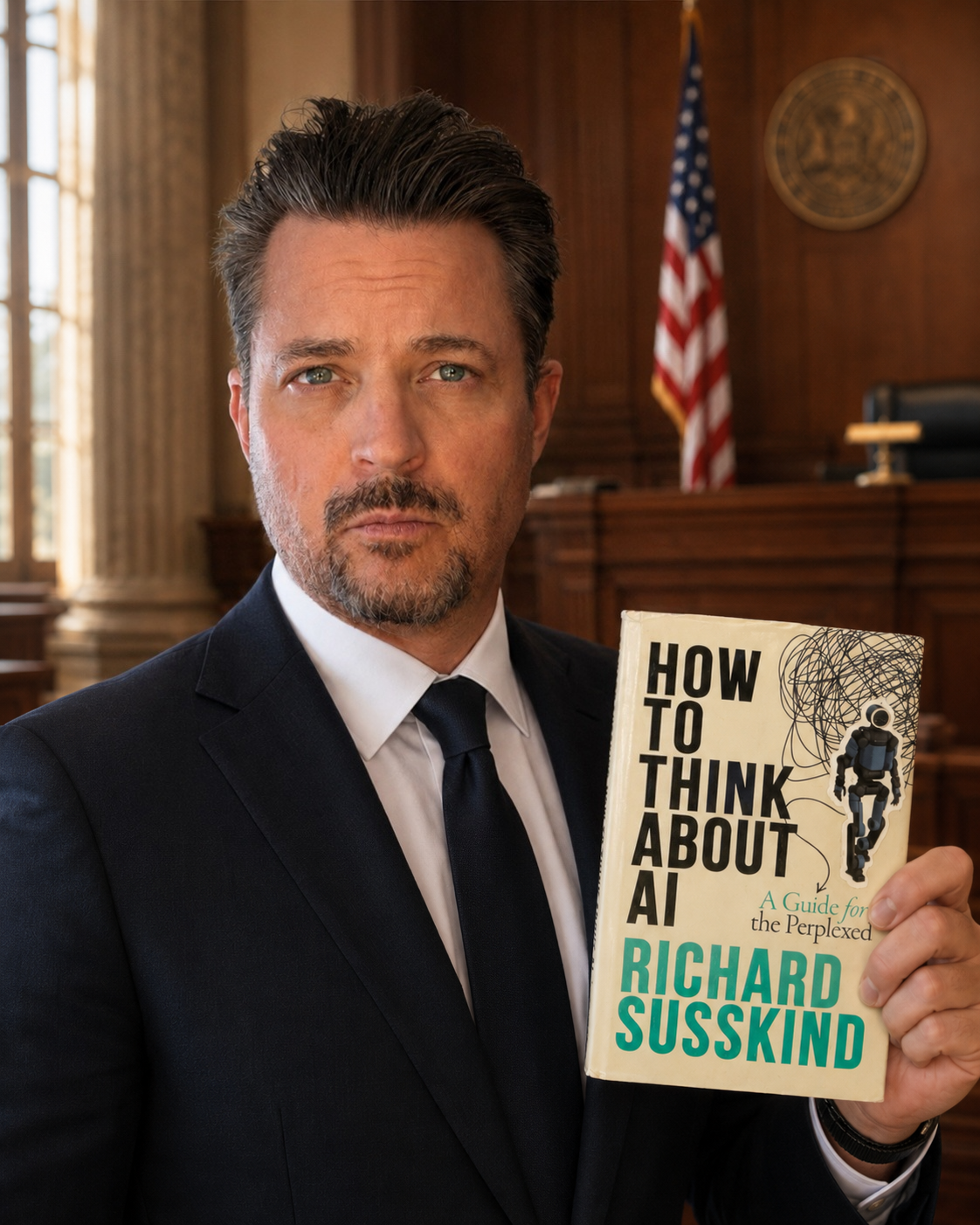
Richard Susskind has spent four decades writing about the future of legal services and, more recently, the broader future of professional work. How to Think About AI: A Guide for the Perplexed is his attempt to give non-technical readers — and especially professionals whose livelihoods touch advice, judgment, and trust — a vocabulary for the decade ahead. It belongs on every lawyer's shelf.
Why this book, for lawyers
Most "AI for lawyers" books are tactical: which tool, which prompt, which workflow. Susskind's book is the opposite. It is a structured way of thinking about what artificial intelligence is, what it is becoming, and what it implies for the institutions — courts, firms, regulators — that depend on human judgment. For Ohio attorneys orienting around the COUNSEL Framework, it pairs naturally with ABA Formal Opinion 512 and the Ohio Supreme Court's AI Task Force Report. The opinions tell you what your duties are. Susskind helps you decide what you believe about where the technology is headed.
The four long-run scenarios
The chapter that most repays a careful read is Susskind's framing of the long-run relationship between humans and increasingly capable AI. He sketches four scenarios — not as predictions, but as the realistic shape of the possibility space.
1. AI takeover
In the takeover scenario, AI systems eventually surpass human capability across most cognitive domains and end up in effective control — by design, by drift, or by our own delegation. Susskind takes the scenario seriously without sensationalising it. The legal-system implication is sobering: institutions built on the assumption that humans hold the final word on rights, remedies, and punishment have no settled answer if that assumption breaks. For practitioners, the takeover scenario is the reason governance, oversight, and human accountability cannot be deferred.
2. Merger
The merger scenario is the one most associated with thinkers like Ray Kurzweil: humans and machines progressively integrate — through interfaces, augmentation, and shared cognition — until the line between "the lawyer" and "the lawyer's tools" is no longer meaningful. Susskind treats this as plausible but uneven. For the profession, the practical question is not whether merger happens in some ultimate sense, but how much of today's "lawyerly judgment" already runs through machine- assisted cognition — and what that implies for competence, confidentiality, and candor.
3. Peaceful coexistence (co-exist at a distance)
In the coexistence scenario, AI becomes extraordinarily capable but remains a tool. Humans and machines occupy distinct domains; AI handles the work it does better, humans retain the work that turns on judgment, empathy, legitimacy, and moral authority. This is the world most current regulation — including ABA Formal Opinion 512 — implicitly assumes. Susskind's contribution is to show that coexistence is a choice requiring deliberate institutional design, not a default that arrives by inertia.
4. Shut AI off
The fourth scenario is the one most often dismissed: societies decide, collectively or in pieces, that the costs of advanced AI exceed the benefits, and constrain or switch it off. Susskind notes that this scenario has historical analogues — human civilisations have, in fact, walked away from technologies — but he is candid about the coordination problem and the asymmetry of incentives. For lawyers, the value of taking this scenario seriously is that it forces the question of what we would be willing to give up, and at what point.
How Susskind uses the four scenarios
Susskind's argument is not that one scenario is right. It is that any serious conversation about AI policy, AI ethics, or AI in professional practice has to acknowledge all four — and that most public debate collapses prematurely into one. Tech optimists argue as if merger is inevitable. Critics argue as if takeover is imminent. Regulators draft as if peaceful coexistence is already secured. And almost no one takes shut-off seriously enough to plan for it. The book's discipline is in holding the four open at once.
What it means for the COUNSEL Framework
- Competence. Knowing the shape of the possibility space is part of the duty of technological competence. A lawyer who can only describe one scenario is not yet competent.
- Oversight. The case for human oversight is strongest in the coexistence scenario and most urgent in the takeover scenario. Either way, the practical answer today is the same: verify, supervise, and document.
- Lifecycle. Susskind's longer arc reframes "lifecycle" from a procurement question to a civilisational one. The tools you adopt today help select which of his four futures becomes likelier tomorrow.
Recommended reading order
- How to Think About AI — Richard Susskind (this book).
- ABA Formal Opinion 512 — for the duties layer.
- Ohio Supreme Court AI Task Force Report — for the Ohio-specific governance floor.
- Stanford RegLab & HAI, Hallucinating Law — for the empirical baseline on model reliability.
Where to read it
The book is available through Oxford University Press and major booksellers. We do not reproduce any of its text; this page is a summary and recommendation only, offered for fair-use educational purposes. Citations and quotations belong to the author and publisher.
This summary is for educational purposes only and is not legal advice. LegalTek.ai is a technology company, not a law firm.
Attribution: This page reproduces public-record material from the Richard Susskind · Oxford University Press. Reproduced and annotated by LegalTek.ai for educational purposes. The original document remains the work of the issuing authority.
Not legal advice: The content on this page is provided for informational and educational purposes only and does not constitute legal advice. No attorney-client relationship is created by reading this material. Consult a licensed attorney in your jurisdiction for advice on any specific matter.
LegalTek.ai is a technology company, not a law firm.