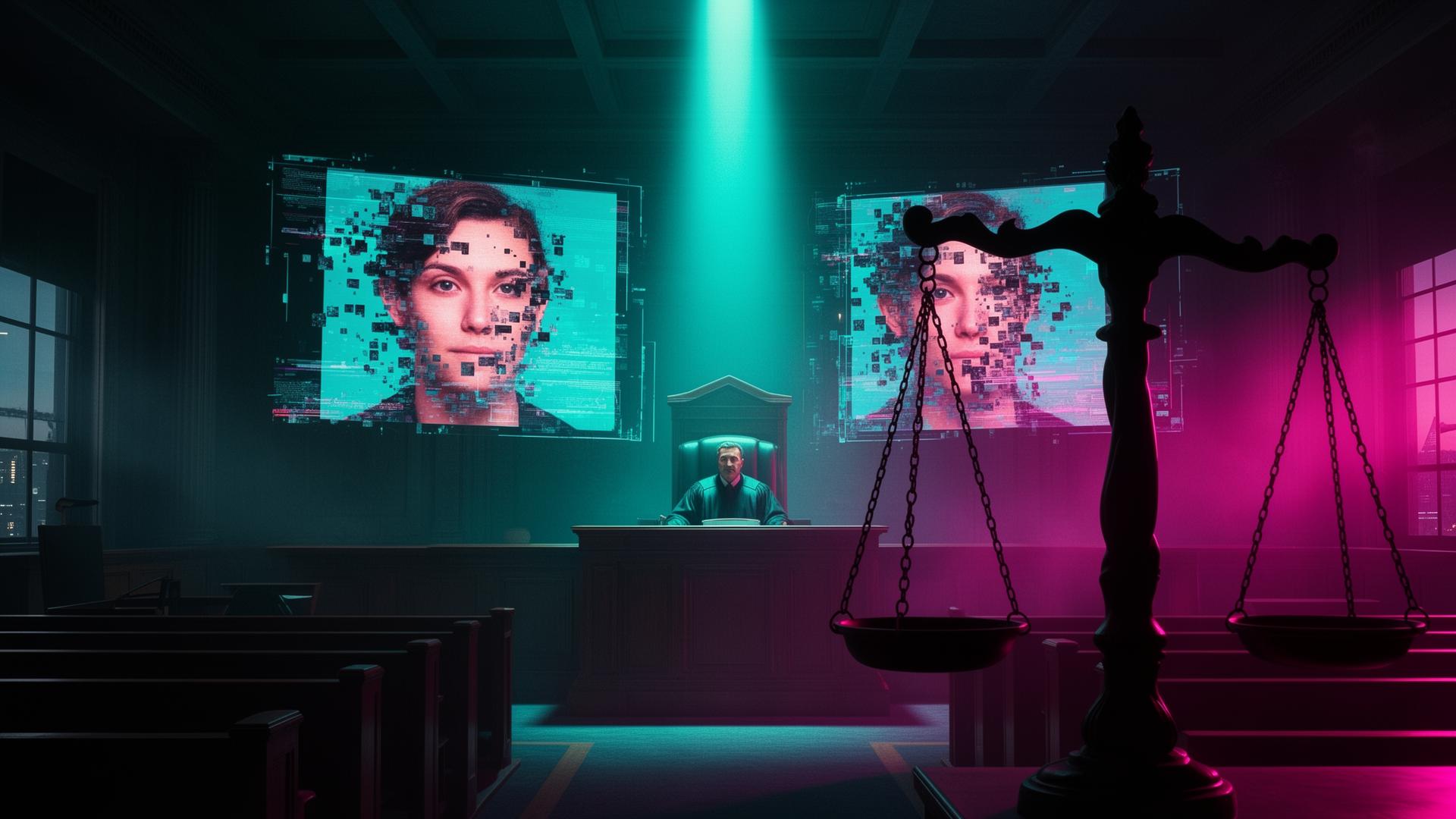
On April 7, 2026, a thirty-seven-year-old man from Columbus walked into the Southern District of Ohio and pleaded guilty to three federal counts. Cyberstalking. Producing obscene visual representations of child sexual abuse material. And publication of digital forgeries — the statutory term the Take It Down Act uses for deepfakes.
The U.S. Attorney's Office publicly stated that James Strahler II is believed to be the first person in the United States convicted under the Take It Down Act. See United States v. Strahler, S.D. Ohio No. 2:25 cr (plea entered Apr. 7, 2026).
Strahler had installed more than twenty-four AI platforms and more than one hundred web-based AI models on his phone. Between December 2024 and June 2025 he used them to generate sexually explicit images and videos of real people without consent. He targeted at least six adult women. He distributed fabricated pornographic video to their coworkers. He sent voicemails containing threats of rape, paired with specific home addresses. He then produced synthetic child sexual abuse material using the faces of real minors from his own community and posted more than seven hundred such images to a website dedicated to that material.
The first person convicted under the Take It Down Act is from Ohio.
Not California. Not New York. Ohio.
I want Ohio practitioners to sit with that sentence for a moment. The deepfake docket did not arrive from the coasts. It arrived in our district, in our time, involving our neighbors. Whatever you believed about synthetic media last quarter, it is now a matter of Ohio criminal practice, Ohio evidentiary practice, and, inevitably, Ohio domestic relations practice.
This is a field report for the lawyers who practice in the courts where this problem actually lands.
Evidence Used to Reflect Reality. Now It Requires Verification.
For generations, the profession operated on a settled premise. A photograph captured a moment. A recording preserved a voice. A video told a story. Jurors trusted what they saw. Judges relied on recordings to reconstruct events. Investigators built prosecutions around surveillance footage.
Generative artificial intelligence has dissolved that premise.
Today, convincing audio can be fabricated from seconds of recorded speech. Entire conversations can be generated. Video of events that never occurred can be produced in minutes. Messages that appear authentic can be created without any human ever sending them.
The question our evidentiary system was built to answer was, "Is this what the proponent claims it is?" Under Ohio Evid. R. 901(A), and its federal counterpart Fed. R. Evid. 901(a), authentication is a low bar. The proponent must produce evidence sufficient to support a finding that the item is what the proponent claims.
That standard was calibrated for a world where fabrication required skill, time, and equipment. It was not calibrated for a world where a laptop can manufacture reality.
The result is not a hypothetical reform debate. It is a live operational problem in criminal cases, civil cases, employment cases, and, as I will show, in domestic relations cases.
The Case Law Is Already Forming
Practitioners often assume deepfake litigation is tomorrow's problem. The reported decisions suggest otherwise.
Huang v. Tesla, Inc.
A California court rejected Tesla's refusal to admit authenticity of a video of Elon Musk's statements about Autopilot — refusing to let public figures disclaim their own recorded statements by invoking generative AI.
Wisconsin v. Rittenhouse
Defense objected to the prosecution's use of Apple's pinch-to-zoom on already-admitted iPad video, arguing the function applies AI processing. The court placed the burden on the proponent to produce expert testimony.
United States v. Khalilian
Defense moved to exclude a voice recording as a possible deepfake. The court suggested lay-witness voice familiarity under Fed. R. Evid. 901(b)(5) was likely sufficient — a standard not calibrated for voice cloning.
Kohls v. Bonta, 752 F. Supp. 3d 1187 (E.D. Cal. 2024)
Addressed videos containing demonstrably false information that had been significantly edited or digitally generated using AI, in the context of California's deepfake statute.
Broadrick v. Gilroy, 2025 WL 1232527 (D. Minn. Apr. 29, 2025)
False-light claim involving AI-generated images.
League of Women Voters of N.H. v. Kramer
2025 WL 919897 (D.N.H. Mar. 26, 2025). Robocalls using AI-generated deepfake voice technology to mimic President Biden to suppress Democratic voter turnout in the New Hampshire primary.
Project Veritas v. Schmidt, 125 F.4th 929 (9th Cir. 2025)
Ninth Circuit addressed unauthorized voice recordings deployed to create deepfake audio files.
Earlier Skirmishes
People v. Smith, 969 N.W.2d 548 (Mich. 2021) (challenge to Facebook posts as fabricated); Schaffer v. Shinn, 2021 WL 6101435 (D. Ariz. 2021) (defendant attacked sentencing-enhancement evidence as a deepfake).
Place Huang, Khalilian, Rittenhouse, Kohls, Broadrick, Kramer, Schmidt, Smith, and Schaffer on the same desk. A pattern resolves. Courts are adjudicating synthetic media questions under authentication rules written for Polaroids. The results are, predictably, inconsistent.
The Liar's Dividend
The most corrosive consequence of generative media is not fabricated evidence. It is deniable evidence.
Consider a defendant presented with authentic video footage of admitted conduct. The historical response was denial of the conduct. The modern response, available to every defendant and every civil litigant, is denial of the medium.
That recording is fake.
That video was generated.
That message was synthesized.
In prior decades, such a denial was implausible. Today it is plausible on its face. The courts have begun calling this phenomenon the liar's dividend, and it has already appeared in family courts. A survivor of domestic violence produces a smartphone video capturing abuse. The accused spouse responds, without expert support, that the video must be AI generated. A custody outcome, a protection order, a criminal charge — each now turns on an evidentiary fight the survivor did not anticipate and may not be able to afford.
The liar's dividend is not a future problem for Ohio domestic relations practitioners. It is the next objection you are going to hear in a full hearing on a Civil Protection Order under R.C. 3113.31. It is the next objection you are going to hear in a contested allocation of parental rights under R.C. 3109.04. And when the magistrate calls for authentication, the cost of proving what everyone in the room already believes is going to fall on the party with the most to lose and the least resources to prove it.
That cost is the real harm. It is a tax on truth, paid by victims, and collected by the architecture of doubt that generative media introduces into every case.
Domestic Relations Is Ground Zero
Criminal deepfake prosecutions will generate headlines. Family court is where deepfakes will generate the most sustained damage.
The reason is structural. Domestic relations practice depends on evidence that is already informal. Text messages. Voicemails. Phone videos. Screenshots. Social media posts. Recordings made in the kitchen, the driveway, the parking lot. This is exactly the category of evidence that generative AI can most easily fabricate and most plausibly contest.
Anticipate the following within the next twelve months in Ohio domestic relations courts:
- An AI-generated voicemail offered as threatening language in support of a CPO petition, with the alleged maker denying the voice entirely.
- A fabricated text message thread offered in a contested custody hearing, with the maker asserting the thread was synthesized to manufacture a narrative of unfitness.
- An AI-enhanced photograph offered in a parenting time dispute, with the opposing party invoking Wisconsin v. Rittenhouse to demand expert testimony on the enhancement pipeline.
- A fabricated bank statement offered in an Affidavit 1 dispute. English family courts are already prosecuting litigants who submitted altered financial disclosures. See Vispute v. Vispute (Eng. 2023).
- A fabricated intimate image deployed to humiliate or coerce a spouse during or after dissolution. The Strahler case shows the upper bound of that behavior. The lower bound, equally damaging to a divorcing family, will not make the U.S. Attorney's press release.
Every one of these scenarios becomes a hearing. Every hearing becomes expense. Every expense becomes a barrier to access to justice.
The Federal Rulemaking Response
The Judicial Conference's Advisory Committee on Evidence Rules has been working the problem. Two proposals have emerged.
Proposed Fed. R. Evid. 901(c)
Addresses potentially fabricated electronic evidence. An opponent showing evidence sufficient to support a finding of AI fabrication shifts the burden — proponent must then demonstrate authenticity by a preponderance under Fed. R. Evid. 104(a). Not yet published for public comment.
Proposed Fed. R. Evid. 707
Addresses machine-generated evidence directly, applying expert-witness reliability standards. Released for public comment in August 2025; comment window closed February 16, 2026. Critics flag a limitation: it governs only acknowledged AI output — not contested AI origin.
The practical point for Ohio lawyers is this. Federal rule amendment is slow. Ohio's Evid. R. 901 mirrors the federal rule. Any Ohio Supreme Court response will follow, not lead, the federal process. That means trial judges, magistrates, and most often domestic relations magistrates are going to be adjudicating deepfake objections under the existing rules, with no circuit or Supreme Court of Ohio authority to guide them, for the foreseeable future.
This is an operational reality. It is also a strategic opportunity for practitioners who prepare.
The State Landscape, with Ohio Arriving
Act No. 250 (HB 178), effective Aug. 1, 2025, amended La. Code Civ. Proc. art. 371 to require attorneys to exercise reasonable diligence to verify authenticity. The first statewide framework placing an affirmative verification duty on counsel.
S.B. 11 (2025-26 Reg. Sess.) directs the Judicial Council to develop court rules to assess claims that evidence has been generated or manipulated by AI, by January 1, 2026.
A.B. 1338 (2025-26 Reg. Sess.) advances a digital-replica framework requiring consent, contract, and compensation for AI-created likeness use.
ELVIS Act, effective July 1, 2024 — first state law outside the intimate-imagery and political-content categories to protect voices against AI manipulation.
Take It Down Act, signed into law May 19, 2025, criminalizes nonconsensual publication of intimate imagery (including AI-generated) and empowered the FTC as enforcement body. Strahler was the first conviction.
S.B. 163, 136th Gen. Assemb., pending before Senate Judiciary Committee. Addresses AI-generated content broadly; contemplates watermarking obligations; expands offenses for AI-generated obscene material depicting minors to a third-degree felony; civil remedies up to $10,000 per violation, enforced by the Ohio Attorney General.
When S.B. 163 passes, Ohio joins the forty-plus states that have already acted. The question for practitioners is not whether your state will regulate synthetic media. The question is whether your practice is prepared when it does.
The Practitioner's Framework
Waiting for courts to define standards is not strategy. Acting before the standard arrives is. Here is the operational framework I am teaching at LegalTek.ai and deploying across my own firm.
Adopt a Firm Governance Policy on Synthetic Media
Every firm — including the small firm — needs a written policy addressing AI-generated content: acceptable internal use, disclosure obligations to clients and courts, incident escalation, and training. ABA Formal Op. 512 and the NIST AI RMF supply the scaffolding. The COUNSEL framework supplies the operational layer. Whatever scaffolding you use, get it in writing and get it signed.
Instrument Your Evidence Handling
Digital evidence entering your office must be handled with metadata preservation in mind. Screenshots alone are insufficient. Original files with native metadata. Secure chain of custody. Hash verification. Preservation notices that specifically request metadata-rich production. These are competence obligations, not best practices.
Develop an Authentication Playbook
Before your next contested evidentiary hearing, decide in advance how you will authenticate and how you will challenge. For proponents: identify the witness or expert who will establish provenance. For opponents: prepare the specific articulable basis under any eventual Rule 901(c) framework, or under existing Rule 901. A bare claim of deepfake should be met skeptically. See Huang v. Tesla.
Build a Forensic Bench Before You Need It
Identify at least one digital forensic expert now. The discipline is narrow and qualified witnesses are few. A named forensic relationship in a Civil Rule 26 disclosure is worth more than any theoretical argument about synthetic media. Metadata analysis, waveform analysis, and model-signature detection are the emerging DNA testing of digital evidence.
Train Staff to Recognize Warning Signs
Apply the Tattle-Tale approach. Every member of your firm — including paralegals and intake staff — should be trained to flag evidence that looks too convenient, too clean, or too perfectly responsive. A video with no ambient sound irregularities. A bank statement dated September 31. A text thread with perfectly grammatical replies from an opposing party known to send one-word messages. Anomalies are signals.
Plan the Incident Response Before the Incident
Assume your client will be targeted. Assume opposing parties will fabricate. Assume authentic evidence will be challenged as synthetic. The preparedness that follows reduces response time, legal exposure, and reputational harm. This is the G3M logic applied to evidence — prepare for the failure mode, and the failure becomes a procedural checkpoint rather than a crisis.
The Real Risk Is Not the Fake. It Is the Erosion of Trust.
Technology introduces new tools. Law introduces new rules. Deepfakes introduce something deeper. Uncertainty about reality itself.
When juries question video. When investigators doubt recordings. When survivors are told their authentic footage must be authenticated before it can be heard. The justice system faces a challenge our evidentiary canon was not written to answer: preserving trust in evidence, and therefore trust in judgment.
Without that trust, litigation becomes procedural chaos and, more importantly, an engine of advantage for the party with more resources to contest everything. With that trust — preserved through updated rules, trained practitioners, and thoughtful governance — the justice system adapts.
The attorneys who understand synthetic media will lead this adaptation. The ones who do not will react to it, often from the losing side of a motion they did not see coming.
Final Thought
Artificial intelligence has not just changed how content is created. It has changed how truth must be proven.
The Strahler conviction in the Southern District of Ohio is not the end of this story. It is the opening paragraph.
The next chapters will unfold in CPO hearings. In contested custody trials. In financial disclosure disputes. In workplace investigations. In criminal prosecutions where the recording is either the whole case or the whole defense. And, eventually, in appellate decisions that will define the contours of Ohio Evid. R. 901 for a generation of practitioners.
The deepfake docket has arrived.
The question is whether your practice has.
Don't Get Sanctioned. Get COUNSEL Certified.
The COUNSEL Framework is the operational layer for synthetic-evidence governance, authentication playbooks, and firm policy. Start where the deepfake docket has already landed.
Recommended Follow-On LegalTek.ai Articles
- Authenticating Reality: A Trial Lawyer's Framework for Deepfake Evidence Under Ohio Evid. R. 901
- The Liar's Dividend: When Defendants Claim Real Evidence Is Fake
- AI Platform Liability: The Next Wave of Product Liability Litigation
- Synthetic Evidence in Ohio Domestic Relations Practice: CPOs, Custody, and Affidavit 1 Disputes
- The COUNSEL Framework: Governance, Disclosure, and Competence in the Age of Generative Evidence
Appendix A: Authorities Cited
Cases
- Broadrick v. Gilroy, No. 24 cv 1570, 2025 WL 1232527 (D. Minn. Apr. 29, 2025).
- Huang v. Tesla, Inc., discovery dispute (Cal. Super. Ct.). Verify docket.
- Kohls v. Bonta, 752 F. Supp. 3d 1187 (E.D. Cal. 2024).
- League of Women Voters of N.H. v. Kramer, No. 24 cv 73, 2025 WL 919897 (D.N.H. Mar. 26, 2025).
- Mata v. Avianca, Inc., 678 F. Supp. 3d 443 (S.D.N.Y. 2023).
- People v. Smith, 969 N.W.2d 548 (Mich. 2021).
- Project Veritas v. Schmidt, 125 F.4th 929 (9th Cir. 2025).
- Schaffer v. Shinn, 2021 WL 6101435 (D. Ariz. 2021).
- United States v. Khalilian (sealed motion practice). Verify docket.
- United States v. Strahler, S.D. Ohio (plea entered Apr. 7, 2026). Verify PACER & DOJ press release.
- Vispute v. Vispute (Eng. Fam. Ct. 2023). Persuasive only.
- Wisconsin v. Rittenhouse, Kenosha County Cir. Ct. No. 2020CF000983 (Wis. 2021).
Statutes & Rules
- Fed. R. Evid. 104(a), 401, 403, 901(a), 901(b)(5).
- Proposed Fed. R. Evid. 707 (released Aug. 2025; comment closed Feb. 16, 2026).
- Proposed Fed. R. Evid. 901(c) (Advisory Committee agenda, fall 2025).
- Take It Down Act, Pub. L. No. 119 (May 19, 2025).
- Ohio Evid. R. 901; Ohio R.C. 3105.10; 3109.04; 3113.31.
- Ohio S.B. 163, 136th Gen. Assemb. (pending). Verify status.
- La. Act No. 250 (HB 178), effective Aug. 1, 2025.
- Cal. S.B. 11, 2025-26 Reg. Sess.
- N.Y. A.B. 1338, 2025-26 Reg. Sess.
- Tenn. Code Ann. §§ 47 25 1101 to 1108 (ELVIS Act), effective July 1, 2024.
Secondary Authority
- Rebecca A. Delfino, Deepfakes on Trial, 74 Hastings L.J. 293 (2023).
- Bobby Chesney & Danielle Citron, Deep Fakes, 107 Calif. L. Rev. 1753 (2019).
- Agnieszka McPeak, The Threat of Deepfakes in Litigation, 23 Vand. J. Ent. & Tech. L. 433 (2021).
- ABA Formal Op. 512 (2024).
- NIST AI Risk Management Framework 1.0 (Jan. 2023).
- Advisory Committee on Evidence Rules, Agenda Book (June 10, 2025).
- Symposium, 92 Fordham L. Rev. 2375 (2024).
Matt Mishak is the Managing Attorney of Mishak Law LLC in Amherst, Ohio, the Law Director for the Village of South Amherst, and the Founder and CEO of LegalTek.ai LLC (d/b/a SilverTung), an AI-powered legal practice management platform for Ohio domestic relations practitioners. He has practiced law for twenty years, including service as Chief Prosecutor. He graduated summa cum laude from Cleveland-Marshall College of Law and completed executive programs at MIT Sloan and Harvard Business School Online in applied artificial intelligence for business.